“The Great Debaters”
HOLLYWOOD VS. HISTORY“The Great Debaters”
Part Twenty-eight in a Series
By Tom Madsen
“Denigrate. There’s a word for you. From the Latin word ‘Niger,’ to defame, to blacken. It’s always there, isn’t it? Even in the dictionary. Even in the speech of a Negro professor. Somehow, ‘black’ is always equated with failure.”
-Professor Melvin B. Tolson (Denzel Washington)
to his student debaters at Wiley College in the film
“The Great Debaters.”
In 2007, Denzel Washington directed an Oprah Winfrey’s Harpo Productions film about the predominately black Wiley College in Marshall, Texas and its 1935 debate team. The plot of the film revolves around the team’s coach and English professor, Melvin B. Tolson (Denzel Washington) as he recruits his four-member team to compete with other black colleges in the United States. The screenplay by Robert Eisele, based after a story co-written by Eisele and Jeffrey Porro, weaves the tale of this small college and its endeavors to establish a competitive debate team. While that is the main subject of the story, there are subplots abounding, including, Southern racism, family dynamics, relationships, the plight of sharecroppers attempting to unionize, the horrors of lynching and personal and academic growth.
Professor Tolson recruits a four member team made up of Henry Lowe (Nate Parker) a brilliant student and poet, with a troubled darker side grappling with the social and racial injustice in the Jim Crow South; Samantha Booke (Jurnee Smollett), a recent transfer student and the only female on the team; Hamilton Burgess (Jermaine Williams), an academically gifted student who appears to be torn between his high academic standards and Tolson’s off campus political activities. Rounding out the debate team is fourteen-year-old James Farmer, Jr. (Denzel Whitaker), the son of the campus Chaplin and professor of theology, James Farmer, Sr. The younger Farmer is a prodigy and while an excellent student, he lacks the social graces and confidence of his fellow undergraduates mainly because of his age.
The motion picture addresses the bigotry faced by not only the debate team and Wiley College, but the African Americans living in east Texas. There are disturbing scenes in the film centering around the violence perpetrated on blacks by white bigots, including a public lynching.
Washington’s Tolson is the main character as one of the subplots revolves around his leadership in forming a sharecropper’s union. He goes far to relate to the sharecroppers, as he “dresses down” in overalls and work shirts when meeting clandestinely with them. As an academician, Tolson wants Wiley’s debate team to compete with white colleges as a way to further legitimize not only the school’s academics, but other black colleges as well.
Wiley’s debate team goes on to systemically defeat all of the black colleges they face around the United States. Tolson’s vision of competing with white colleges comes to fruition when they are invited to debate Oklahoma City University, which they defeat. Then, after building a national reputation, Tolson receives a letter from Harvard University inviting Wiley to compete with the Ivy League school’s national championship debate team.
Tolson, however, has to recuse himself from attending the Harvard competition due to being on parole for attempting to unionize sharecroppers and cannot leave Texas. Then, just before the team leaves for Cambridge, one of the four team members, Hamilton Burgess, drops out because he doesn’t believe in Tolson’s extracurricular political activities, leaving the three remaining team members to travel to the East Coast alone, with Lowe as their leader. Just before the contest, Lowe announces to Booke and Farmer that he will not participate against the Harvard team. Leaving the two younger debaters to face the trenchant Harvard team by themselves. In typical Hollywood fashion, Farmer delivers an emotional and poignant summary that solidifies the victory for Wiley. They are given a championship trophy and the movie ends with a brief post-Wiley biography of Tolson and the team.
“The Great Debaters” is a well-acted and directed motion picture. It has, however, one glaring problem – most of it is fiction. In the opening credits, the producers place on the screen the following disclaimer:
“[A] drama based on the true story of Melvin B. Tolson.”
Or, as journalist Gregory Beamer wrote in Word Press: “[It] had a lot less ‘true’ than story.”
In the film, most of the events appear to take place in 1935. In reality, the stories retold in the movie occur over a sixteen-year period – 1923 to 1939.
With the exception of Denzel Washington’s Melvin Tolson, Forest Whitaker’s James Farmer, Sr. and Denzel Whitaker (no relation to either Denzel Washington or Forest Whitaker) portraying James Farmer, Jr., the rest of the principal characters may be loosely based on real people and may have some similarities to them, but, for the most part, they are total fiction.
In the film, the character of Samantha Booke appears to be based after Henrietta Bell Wells, the first female on the Wiley debate squad in 1930, which means she never participated in the college’s 1935 historic team. By the way, the 1930 Wiley team was the first black college to compete and defeat a white college, the University of Michigan Law School.
In the film, Booke has a tumultuous relationship with fellow debater, womanizer and heavy drinker, Henry Lowe, who apparently is based after the real-life Henry Heights. Heights was the “anchor” for the 1935 team, making it highly unlikely of a Wells/Heights friendship, much less a romantic liaison. Also, while the character Samantha Booke may be based on Henrietta Bell Wells, there were no women on the 1935 Wiley debate team. While Heights was not the troubled character like the fictional Henry Lowe, it is believed Heights became a minister and eventually settled in California, but, besides that, his life history is basically unknown after his college career.
While the film casts Booke and Farmer, Jr. as the representatives of the Wiley Debate team versus Harvard, first, in reality, Wiley never debated Harvard. They went up against the national champion University of Southern California on April 2, 1935. Second, the debaters for Wiley in that contest were Hobart Jarrett and Henry Heights. James Farmer, Jr. served as a researcher and was in the audience during the debate.
Even though the USC debate ended in a “no decision,” the mere fact that a small African American College from Marshall, Texas could compete with the country’s top placed college debate team is and of itself remarkable. The Wiley team was never given the chance to be proclaimed national champions by Pi Kappa Delta, the American honor society and organization for intercollegiate debaters, public speakers and instructors because of the American racial laws in force at that time. Still, Wiley was given the moniker, “The Great Debaters.”
Like so many of Hollywood’s period pieces, “The Great Debaters” was a very well-made motion picture, but for some (and, by Hollywood standards, consistent) reason, it was compelled to rewrite history and essentially alter the original story. “The Great Debaters” appears to stumble into the same sorry trap many Hollywood movies fall into: the need to make it more captivating and dramatic to either appease the fickle motion picture audience, or the unwarranted belief that the historic story is not dramatic enough and will not sell. That, of course, is just so much nonsense. The historic Wiley team did not and does not need help from any Hollywood screenwriter to tell the amazing story of a small black college in the throes of the horrible Jim Crow era, especially in the racist South, that rises above the social and political segregation and violence of that time to compete and show the rest of America the hidden talent that was the African American community then, as it is now.
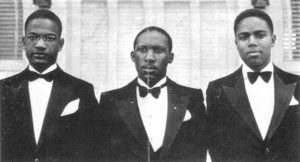
The “real” debaters: L-R: Hobart Jarrett,
Henry Heights and James Farmer, Jr.
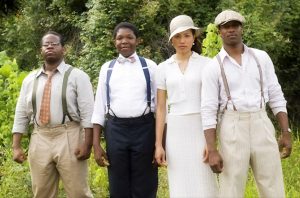
The “reel” debate team: L-R Hamilton Burgess (Jermaine Williams), James Farmer, Jr. (Denzel Whitaker), Samantha Booke
(Jurnee Smollett) and Henry Lowe (Nate Parker).