Yoder’s Asphalt Maintenance & Sealcoating
Owner Felty Yoder
N5759 Division Road, Cecil
715-701-3734
Felty Yoder and his crew are ready for the driveway sealing season to begin this month.
Yoder, who owns Yoder’s Asphalt Maintenance & Sealcoating, has been in the industry for five years. He learned the business working with Jeremy Kauffman, who owned Jeremy’s Asphalt, and bought the business when Kauffman moved to Colorado.
“I learned a lot from him and then took it from there, learning how to put the product down and see how the finished product is going to be. I just experienced a lot on my own to see what works and what doesn’t,” Yoder said.
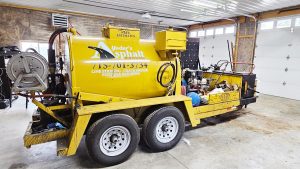
Last fall he bought a new sealcoating machine that includes a large tank and room to carry a variety of tools, and it’s serving him well.
“We’ve done a lot of jobs, a lot of happy customers, and it’s something I like to do. I like the kind of work it is. I like to work when it’s warm and it’s something I enjoy doing,” Yoder said.
Prep work is the key to the best application result.
“First you have to clean the driveway in order to get a good finished product. That’s something I focus on a lot,” Yoder said.
They use power brooms, a wire brush, a blower and a variety of other tools to prepare the driveway, get the grass away from the edges, and clean out cracks. They fill cracks with hot tar and repair potholes before sealing the driveway.
“You have to use a good tar to get a good result,” he said.
Helping with the cleaning are his two nephews, Perry and Lyndon Borntrager.
“It’s good to have them on the crew. They can run the hoses, they can run the blower. They do a lot of the cleaning part of it where they can keep on going while me and Ryan (Lohrengel) start filling cracks.”
Lohrengel, of Shawano, is their driver and big part of the operation.
“We use his truck (to haul the sealing machine). He helps out a lot. He’s one of the main guys on it as far as working,” Yoder said.
Yoder uses a commercial-grade asphalt emulsion made by Mix-Tek Pavement Solutions of Necedah, WI, which he said is the best product. They go through roughly 40,000 gallons a year. The sealer has sand in it to help build up the driveway. They can do four to six jobs a day.
“I take pride in what I do. You’ve got to know how to handle that wand and you’ve got to know how to cover every area the right way with the right amount of sealer,” Yoder said.
He puts on a double coat, overlapping layers as he goes, focusing on how it looks.
“When I’m putting this down, I want to see it look even, I want to see it look to where everything looks the same, and you’re going to have a good finished product,” Yoder said.
Yoder does the job estimates and has been busy scheduling work for this season. They are booked into mid-June for jobs so far.
“We’re getting booked out, but we’re not that far out. We probably can still do a lot of jobs before the 4th of July,” Yoder said.
So far the calls have come from many first-timers and year-to-year clients. Many customers have seen ads in the Market Messenger and come from client referrals.
It’s recommended to reseal an asphalt driveway every three to five years.
“Some customers do it every three years, and I’d say that’s the best way to do it depending on the asphalt on your driveway, how bad it is before you started to do it. I would recommend every three to four years to do that,” Yoder said.
The solution had been an oil-based product many years ago, but that was banned because of toxins, and they work with the asphalt emulsion, which adheres well to driveways.
He said they usually start jobs the second or third week in May, once night temperatures are above 50 degrees. The season ends in fall once temperatures are back under 50.
“Your asphalt gets too cold, and your product gets too cold and it doesn’t cure right. I don’t like to start too early and I don’t like to stop too late,” Yoder said. “You have got to find where the temperatures are right. It’s not just all about taking the people’s money. It’s about having a finished product that’s going to last and look good.”
It takes two to three days for the sealant to cure, depending on whether the driveway is in a sunny or shady location. Usually 48 hours is enough, but if it’s a shady area, three days is better.
They charge by the square foot, with an average driveway is somewhere between 600 and 1,000 square feet. He has a minimum charge of 400 square feet, even if it’s smaller than that. The rise in oil prices has not had an impact on his business for the product.
He also does commercial work, which includes sealing and parking lot line striping.
“When I do something like this, I like to run it. There are big companies out there that have four crews on the road every day, but I’m the type of guy that when I do something like this, I feel confident that it’s done right.”