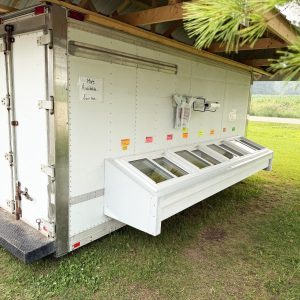
Three Springs Native Nursery
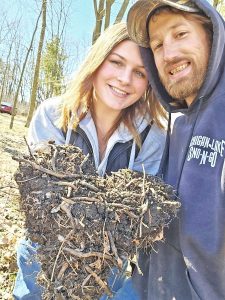
Sage Hansen and Quentin Rickert own and operate Three Springs Native Nursery in Clintonville. They are shown here holding a heart-shaped clump of Wild Ginger.
N10969 Hwy 22, Clintonville
(262) 470-5633
When Quentin Rickert bought a small parcel of land near Clintonville in 2023, his intentions were to run a small, off-grid AirBnB and then build a food forest demonstration site, but that changed quickly and that space today is home to Three Springs Native Nursery.
Rickert, who had worked as a Title 1 teacher in Milwaukee and later with a small landscape company in Appleton, said the unique value and beauty of the land compelled him toward preserving, protecting and educating about what he called the “mighty remnant fen/woodland” he now owns.
Shortly after purchasing the land, he met Sage Hansen, a florist at Events Everlasting in New London, who had similar visions.
“Luckily for us,” he said, “this wonderful forest contained three fresh, flowing springs — thus, the name for the nursery. To date, we have identified more than 220 native trees, grasses, forbs and more across our 4.5 acres along with more than a dozen Bur Oak trees that are more than 200 years old. In the future, we wish to develop a learning center based around our unique remnant ecosystem.
“Then, last year we found our first home, a little log-cabin paradise right down the road from our forest,” he said. “Things were just meant to be as life began to take root in our new community of Clintonville. As we continue to grow into our new place in life, we look forward to sharing our passion for native plants and all things nature with all who cross our path.”
The nursery, Rickert said, is a place to attract people who have an interest in native plants and also provides them the opportunity to experience and learn about the many benefits that come from healthy native ecosystems.
“As a nursery grower, I pride myself on understanding each of my plants — where they grow, how they germinate, which techniques they require, and subsequently, how they perform in different areas,” he said. “Our opening weekend sale earlier this month consisted of 35 species that are second-year plants or mature divisions. As our seedlings begin to put on more size and durability, I will be adding them into our Native Nursery’s offerings. This is our first full year, so it may take a year or two of full production to build up a larger amount of second-year plants that will increase the diversity of our nursery’s offerings earlier in the growing season.”
Rickert said has no intentions of sourcing plant “plugs” from larger wholesale growers.
“Any registered nursery can go and order thousands of dollars worth of native plants and have them shipped up from Milwaukee or Chicago,” he said. “They get potted up from ‘plug’ form and are marked up to make a profit. Once they get in the customers hands, plants will be on a different growth cycle than our natural ones here in north Wisconsin. I try to mimic nature through staying local, doing the work, learning the steps, and producing a regionally valuable product without the middle-man markup.”
According to Rickert, he collected 113 plant species last year in Outagamie, Waupaca and Shawano counties and the plants that grow from that locally collected seed are highly adapted to the area’s specific growing conditions.
“Folks in the native plant world refer to that as being ‘eco-type specific,’” he said. “Not everyone will get into native plants deeply enough to focus on that form of specificity, but there is a growing focus on being responsible and sustainable in our growing practices.”
Many of the nursery’s plants are lower ground covers that would work well to border sidewalks and front porches. Some plants, such as the native mint, allium, violet, and strawberry families can be incorporated into large pot planters that come back year after year. There are other plants that grow to large heights and can be utilized as statement pieces in existing flower beds.
Some of the nursery’s best sellers are:
•Wild Lupine, a drought tolerant plant that can handle sandy and acidic soils and supports the endangered Karner Blue Butterfly.
•Wild Geranium, a groundcover plant that will grow in heavily shaded areas, often under trees. It can also be utilized as a border to pathways.
•Wild Ginger, a groundcover plant for underneath pines and heavy shade. It creates large, dense clusters.
•Bergamot/Bee Balm has a nice smelling foliage and is a complement to most any type of garden/flower bed planting. It can be used as a medicinal herb and reseeds well.
Other favorites are:
•Rocky Mountain Blazing Star, a clumping plant that can be used as a statement piece in the garden. In late summer, Rickert said it’s not uncommon to see groups of Monarch butterflies nectaring on one plant at the same time.
•Any of the Milkweeds — some species are more aggressive in the way they spread than others, but all of them provide the necessary material for the Monarchs to survive. (Common Milkweed, Swamp Milkweed, Whorled Milkweed, Butterfly Milkweed, Poke Milkweed, Green Spider Milkweed, etc.)
“Most people like to reduce landscape maintenance around their home,” Rickert said. By choosing native plants, people can begin to create landscapes that require less maintenance and provide benefits to the birds, bees and butterflies that help us feel our connection to nature once again. It is hard not to stand in awe of a beautiful Monarch or Giant Swallowtail butterfly and not want to learn more about how to see them more frequently.”
Rickert said he and Sage hope to continue to grow and expand their Native Nursery.
“The first step in that process,” he said, “will be to purchase a true greenhouse that is between 20 x 50-foot to 20 x100-foot in size. We will likely put that on Sage’s parents’ property in New London. Building infrastructure for that will open the door to growing a larger volume of each species we carry. The long term goals for our wooded nursery location will be to continue developing its ability to serve as a community gathering and learning space. In the future, I will be doing speaking and teaching engagements throughout the off-season months.”
Ultimately, he hopes he and Sage can add a learning center as part of Three Springs Native Nursery as they both enjoy teaching others about native plants, but for now, they have to focus on selling their plants.
“That is a sort of chicken and the egg type of thing,” Rickert said. “I’m an educator at heart, so everything I do comes with a lesson on the side. Right now the selling of plants comes first because that is what will keep the roof over our heads, but as we gain traction, I hope we can focus our time more on education and outdoor experiences with various groups from the community, from students to researchers or just your every day garden club. The focus should be able to shift gradually after a few years given I build out the infrastructure that would free up more of the time for those educational opportunities”.
Sage, he said, has supported him every step of the way — from collecting seed, building the greenhouse, managing its snow loads when he’s busy plowing in winter or watering plants if he gets tied up with other tasks at the nursery.
“Beyond the small behind the scenes assistance, she is also a wonderful artist and has done the graphic design work for our logo,” he said. “As we progress, we will be looking at finding ways to create more elements that display both her artistry and native plants together.”