Slavery: America’s Abomination; Part One: The Origins of Slavery in The New World
By Tom Madsen
“One day a big ship
stopped off the shore.”
“A big boat was down
at the edge of a bay.”
“For innumerable Africans, the appearance of a strange ocean-going ship signaled the end of their lives as free people. Whether captured by European or African slave traders, or enslaved as prisoners during war, the Africans’ fate was the same – to be shackled, confined in a ship, and transported across the ocean and sold into a life of forced labor.”
– National Humanities Center: “The Making of African American Identity”
We will never know for sure when the first slaves were brought to what the Europeans called The New World, but, for now at least, it is understood slavery “originated” in North America in 1619 when the English privateer, The White Lion, captained by John Jope, sold “20. and odd Negroes,” to the Jamestown Colony in Virginia. Jope’s “Negroes,” a total of anywhere from 60 to 350 (the records were, to say the least, inconsistent), called Angolans, because it was believed they were from the West African country of Angola, had been stolen from a squalid and overcrowded Portuguese slave ship, believed to be in route from Angola to Mexico, or, perhaps, somewhere in the Caribbean.
Governor of the Jamestown Colony, Sir George Yeardley, bought the twenty or so Africans to work alongside of white indentured servants who were brought to Virginia from England.
In West Africa at that time, the business of slave trading was beginning to thrive. It involved the Spanish, the Portuguese and some West African tribes involved in a civil war. It was during this war that many Angolans were kidnapped by West Africans in concert with the Portuguese, then shipped to the Americas, or as the Angolans called it, “the Land of the Dead.”
It is believed that by the beginning of the 1600s there may have been upwards to several million slaves in the Western Hemisphere. It would eventually be called the Transatlantic Slave Trade, encompassing victims and captors from both sides of the Atlantic in the cruel enterprise of human bondage and trafficking.
It’s been over 400 years since “first” African slaves were brought to what would eventually be the United States. The slave trade at that time was more than abundant in the New World and especially the Caribbean. To be sure, the presence of Africans in the Western Hemisphere predates 1619 by almost a century. In 1526, for example, a number of African slaves were brought to what is now South Carolina as part of a Spanish expedition. In November of that year, the Africans staged a revolt against their kidnappers and destroyed the settlement, which the Spanish abandoned soon thereafter. The fate of the Africans is unknown.
According to historian Michael Guasco, in the 1500s it is estimated that as many as 500,000 Africans had “already crossed the Atlantic against their will, and aided and abetted Europeans in their endeavors, provided expertise and guidance in a range of enterprises, suffered, died, and – most importantly – endured.”
The colonization of the Western Hemisphere was a multinational affair; by the 1500s, not only were the British settling in the New World, but also the French, Spanish, Dutch and Portuguese. All were seeking to control the people and the vast resources found in the Americas. And, to do that, they would need an abundance of labor, which was not readily available, thus, the origins of African slavery in America.
*****
In the decades before the American Revolution, slavery could be found in all thirteen colonies. As the North industrialized over the years, the need for considerable numbers of cheap labor diminished. Most of the New England agricultural businesses were small family-operated farms where workers were usually family members, hired hands or, in some rare cases, indentured servants (which is really the same as slavery, only with a gentler name). The slave culture in the North faded due to industrialization, its early origin of urban living and the lack of large-scale agricultural concerns.
The South, however, was different. Their cash crops were rice, cotton, sugar and the up and coming profitable, tobacco. All four took much manpower and in the minds of the plantation owners required a cheap workforce to ensure profitability. As the South’s agribusiness grew, so too, did the social structure of an American caste system that eventually included slavery. The more the white, Anglo population thrived, the more their African slaves suffered and started to be treated as property. As the American slave industry grew, so did the prejudices against races that were considered lower, not only on the economic scale, but on a mental, social and cultural scale as well. In other words, as slavery grew, so too, did the philosophical practice of racism.
After the American Revolution, and as the young nation was forming its government, the presence of the South and its institution of slavery was written into its laws. The Founding Fathers tacitly approved slavery when they accepted that part of the Constitution, which established representation in Congress through population, by counting slaves as “three-fifths” of a person. While African slaves had no rights what-so-ever, they were still included (albeit partially) in the census, so the South could maintain a powerful voting bloc in Congress.
One major problem the plantation owners faced in the South was that cotton took a terrible toll on the soil. By the late 1700s the southern plantations were facing an economic uncertainty, which could have forced the growers to seek alternative, less labor-intensive crops. Still, the textile industry in the North and in England required huge amounts of cotton, which ensured a very lucrative income for the plantation owners. The demand was definitely outweighing the supply. Without a more efficient way to pick seeds from the cotton fibers than by hand, and the strain cotton put on the soil, the South’s economic future would be in peril.
Then, in 1793 a schoolteacher from New England, Eli Whitney, invented the cotton gin, a device that could remove the seeds mechanically and faster from the cotton plant. With the development of the cotton gin, more southern plantations went from tobacco, still one of the region’s major crops, to cotton, which increased the need for more slave labor to prepare, plant seeds and to harvest the cotton from the fields.
In the meantime, between 1774 and 1804, all of the northern states abolished slavery, even as it continued to grow in the South due to their agrarian economy. It grew so exponentially, about one-third of the South’s population was made up of African slaves. As the number of plantation families grew, they became more dependent on slave labor, for not only in their agri-business, but also other aspects of southern life. Finally, as the slave population continued to increase, and for their own protection, the white plantation owners came up with a number of “laws” to govern how their black slaves would live. They would be called “The Slave Codes.”
Essentially these codes were based on the fact that slaves were not persons, but property; and as a result, had no rights what-so-ever; the codes were established to protect the slave owner and his family from not only harm that could be perpetrated on his family by the slave, but also to protect the investment on his “property.”
Each state would have codes developed for their own unique circumstances and culture. Some codes were common among the states, such as the color of one’s skin. If the person in question had any amount of “African heritage,” that person was considered black and subject to the Slave Codes. For instance, should a female slave give birth to a child conceived by a free white man, that child would be considered black, even though the child would be half white and the offspring would become part of the slave owner’s property, but not his family.
Other codes included not being able to leave the plantation without permission; no contact with whites unless approved by their white master; no property ownership; the slaves could not be taught to read or write, nor could they get married. Any violations of the Slave Codes could result in a flogging, branding or imprisonment. In extreme cases, like violence toward a white person could result in death. In the South, even free backs were subjected to the Slave Codes; they could no longer own guns or have white people as their employees.
As conditions worsened some of the African slaves fought back as best they could. Gabriel Prosser, a twenty-five-year-old son of an African-born mother, led the first slave revolt in 1800. A religious zealot, his goal was to establish an independent black state in Virginia and make himself king. Gabriel had planned to seize weapons and kill as many white people as he could. As he and his army of slaves made their way to an arsenal in Richmond, Virginia, a torrential rainstorm washed out bridges and roads, impeding their progress. Before Gabriel’s forces could regroup, Governor (and future president) James Monroe ordered the state militia to surround and capture the insurrectionists. Gabriel and thirty-four of his cohorts were arrested, tried and hanged.
Twenty-two years later, in 1822, Denmark Vesey, a self-educated slave who bought his freedom for $600, led a revolt only to be captured, convicted and eventually hanged.
But the most harrowing of the slave revolts was Nat Turner’s Rebellion held in Southampton County, Virginia in August of 1831. With an army of seventy-five blacks, both enslaved and free, Turner, believing he was acting under God’s orders, murdered sixty white men, women and children over the course of two days until armed residents and the state militia overwhelmed his revolution. Turner was captured two months later; he was tried and eventually executed.
Many in the South used Nat Turner’s Rebellion as evidence that blacks were uncivilized, could not be trusted, were inferior to whites and would instill on the white Anglo population a fear of anyone whose skin was black. As a result, the already abhorrent Slave Codes became even more brutal.
In the following decades, the United States would have to come to grips with the South’s “peculiar institution” through politics, compromise and eventually armed conflict.
Next: The American Revolution, Compromises and the Growing Pain of Slavery
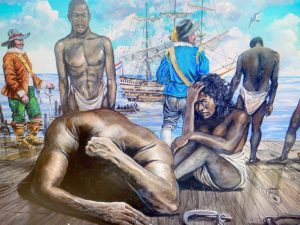
A modern day rendition of African slaves being docked in “The New World” after crossing the Atlantic Ocean.
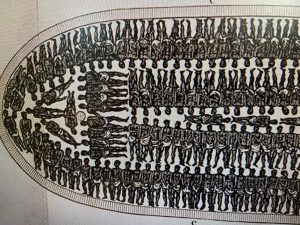
A woodcut of a deck of a slave ship circa 1808
by London artist, Thomas Lehrman.
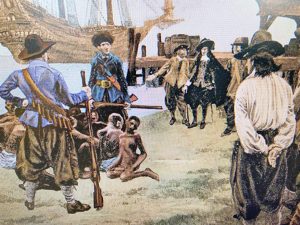
A 20th century artist’s impression of slaves
landing in America, waiting to be auctioned off.