Star Trek at Sixty: To Boldly Go…
By Tom Madsen
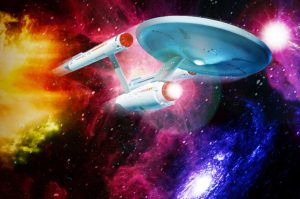
In 1964, writer, producer and former World War II bombardier, Gene Roddenberry came up with an idea for a new television series. A futuristic, “celestial western” (as he called it) about a starship (note: not a spaceship) named the USS Enterprise, that would traverse around the galaxies to “seek out new life and new civilizations” and “to boldly go where no man has gone before.” In a television era of comedies, variety shows and westerns, selling a science fiction TV show about a multi-racial space crew from some future civilization just didn’t “feel” like it belonged on American television in the mid-1960s (note: science fiction movies were still popular on the big screen). After all, TV back then was inundated with comedies (“The Dick Van Dyke Show”, “The Beverly Hillbillies”), Varieties (“The Ed Sullivan Show”, “The Hollywood Palace”) and Westerns (there were so many, take your pick). While there were a few shows that stepped into the more surreal concepts of storytelling, like “The Twilight Zone” (1959-1964), “The Invaders” (1967-1968) and “Journey into the Unknown” (1968-1969), a series about a starship travelling throughout space and coming from a utopian, inter-planetary society was not your usual narrative, especially in 1966 when the United States was in the beginning stages of an increasingly unpopular war in Southeast Asia and as campuses and cities were erupting not only over that war, but civil rights and an assortment of other divisive issues.
Roddenberry tried to sell his idea to the networks as a “Wagon Train to the Stars.” He told friends it was something more like Jonathan Swift’s “Gulliver’s Travels”, only this time a journey throughout the universe with a moral lining.
Desilu Productions sponsored the first pilot of “Star Trek” in early 1965. It was titled “The Cage” and starred Jeffrey Hunter as Captain Christopher Pike, Majel Barrett (Roddenberry’s wife) as First Officer “Number One” and Leonard Nimoy as the Vulcan alien, Mr. Spock. The first draft of the pilot had Spock as a Martian.
Executives at NBC did not care for the pilot as they thought it was too “cerebral” and rejected it. Then, Lucille Ball, the owner of Desilu, took an interest in the show’s development and insisted on another pilot. Filmed in July of 1965, the pilot was titled “Where No Man Has Gone Before.” William Shatner’s Captain James T. Kirk replaced Hunter’s Captain Pike; Nimoy’s Spock remained, but was now the science officer and second-in-command. Also included in the new pilot’s cast were James Doohan as Chief Engineer Montgomery Scott and George Takei as Lt. Hikaru Sulu, the ship’s physicist. After the series was picked up, he became its helmsman.
After pressure from Lucille Ball, NBC accepted the new show. It premiered on September 8, 1966. Added to the cast of regulars were De Forest Kelly as Dr. Leonard “Bones” McCoy, the ship’s doctor and Nichelle Nichols as Lt. Nyota Uhura, the communications officer. In the show’s second season, Walter Koenig was cast as Ensign Pavel Chekov, thus creating a television version of an inter-planetary United Nations. Kirk was from Iowa, Spock from some far-off planet called Vulcan, Scott, a Scotsman (ya think?), Uhura from the futuristic and fictional United States of Africa, Sulu, Japanese-American, Dr. McCoy, a country doctor from Georgia and Ensign Chekov was Russian.
At first half season of “Star Trek” enjoyed very good ratings. But as that initial season progressed, it fell to 52nd out of 94 slots. While it was given a second season, mainly due to Ball’s insistence and an intensive letter-writing campaign by the show’s rather small but vociferous fanbase, NBC moved the show from a primetime Thursday night slot, to Friday night, which was considered a place where unpopular television shows go to die.
After the third season, even with “Star Trek’s” almost cult-like following of enthusiastic viewers clamoring for more life, NBC cancelled the series after seventy-nine episodes. Sometime thereafter Paramount Studios purchased the entire series from Desilu and by 1969, the show was put into syndication.
During the ensuing years, “Star Trek” became a cultural phenomenon. By the mid-1970s, it was being viewed in over 150 domestic and 60 international markets. “Star Trek” conventions sprang up across the country and became very popular vehicles to promote the series and kept it in the public eye. Then, after the popularity of George Lucas’ “Star Wars” (1977) and Steven Spielberg’s “Close Encounters of the Third Kind” (1979) Paramount decided to resurrect “Star Trek” in the form of a Hollywood movie.
With much anticipation, “Star Trek: The Motion Picture” premiered on December 7, 1979, reuniting the original cast and adding a few new characters. The movie, however, was met with mixed reviews. One criticism, in particular, noted it appeared the producers were more concerned about special effects instead of storyline, which was contrary to the original television series. The costuming, the set design and the screenplay were criticized for not capturing the spirit of the television show. Even the new Starfleet uniforms were compared to pajamas. Never-the-less, the movie made just enough profit to warrant a second, or, more likely, a last chance movie.
On June 4, 1982, “The Wrath of Khan” was released by Paramount. “Khan” was an updated continuation of one of the more popular series episodes; 1967’s “Space Seed.” The movie brought back Ricardo Montalban as the evil, genetically engineered genius, Khan Noonien Singh. In the 1967-episode, Khan had been transplanted from the 20th century to the 23rd century and wreaked rebellious havoc among the crew of the Enterprise with his mind-controlling methods. In the new movie, Montalban was at his hammy best, along with the better uniformed original crew of the Enterprise, returning to their more humane television personas. “The Wrath of Khan” was a success and essentially saved the franchise.
“Khan” spawned four other theatrical releases, two of which were direct sequels: “The Search for Spock” and “The Voyage Home.” Both reminiscent of the original series with the usual plot twists, conflicts with the Klingon warrior society, great dialogue, the constant one-sided arguments between McCoy (“You green-blooded hobgoblin…”) and Spock, time travel and tremendous one-liners.
The “Star Trek” franchise has had six mainstream network series’ (including a short-lived animated series from 1973 to 1974), all of which portrayed the Star Trek universe in different time periods and storylines. Of late, every Star Trek spin-off, beginning with “The Next Generation”, continuing through today’s streaming shows are titled with a “Star Trek” prefix, for instance, “Star Trek: The Next Generation” or, “Star Trek: Strange New Worlds.” For sake of time and space, we will forgo the precedent and stay with the show’s original main titles. The first spin-off was “The Next Generation” 1987-1995 (152 episodes), followed by “Deep Space Nine” 1993-1999 (176 episodes), “Voyager” 1995-2001 (172 episodes) and “Enterprise” 2001 -2005 (98 episodes). These shows did not allow the franchise to merely rest on the laurels of the original 1966 “Star Trek”, but further expanded Gene Roddenberry’s vision.
As home entertainment grew into streaming in the late 2010s, so too, did the “Star Trek” franchise with seven new series, including: “Discovery” 2017-2024 (65 episodes), “Short Treks” a series consisting of 10-to-15-minute standalone short stories tied to “Discovery” 2018-2020 (10 episodes), “Picard” 2020-2023 (30 episodes), “Lower Decks” 2020-2024 (50 episodes), “Prodigy” 2021-2024 (40 episodes), “Strange New Worlds” 2022-Ongoing (40 episodes through 2026) and “Starfleet Academy” 2026-Ongoing (20 episodes through 2027).
From the 1970s on, Star Trek has been a major part of American culture and entertainment. It has produced thirteen theatrical motion pictures from 1979 to 2016 and twelve television series.
A made-for-television movie, “Star Trek: Section 31” was produced and released by CBS Studios on January 24, 2025 to mostly negative reviews. While there had been discussions about a sequel, it appears to have been put on hold, at least for now. Still, Paramount and CBS are continuing to explore other Star Trek storylines.
So, how did a short-lived, mid-1960s science fiction television show last so long and has had such a cultural and commercial impact worldwide?
Well, for starters, it has to be the writing. The original “Star Trek” was a mixture of morality plays, political and social stories, with just the right amount of subtle humor and ethnic diversity, which was usually unheard of at that time. But also bear in mind, like so many of the classic television shows from the 1960s, “Star Trek” also had its share of rather mediocre, episodic storylines. The entertainment side of “Star Trek” was not perfect.
Nevertheless, it survived for three seasons, then went on to become a syndication sensation. The casting and development of the main characters played a major role in the success of the franchise. Beginning with the intense, alpha male Captain James T. Kirk, as portrayed by Canadian William Shatner, the cast was a study in worldly (and not so worldly) protagonists. Each of the principals brought an exceptional trait to their characters. De Forest Kelly’s Dr. McCoy was a curmudgeonly sort, with a streak of humanity and heart, which made the stoic Spock an antagonist, as they argued the morals of humans as opposed to Vulcans. James Doohan’s Lt. Commander Scott, from Aberdeen, Scotland, the overseer and master of the Enterprise’s mechanics. Kirk may have been the captain; Scotty was the ship’s father. Nichelle Nichols’ Lt. Uhura was the intergalactic voice of the Enterprise and its highest-ranking female. George Takei’s Lt. Sulu was born in San Francisco; a distant descendant of the Japanese-American internment during World War II. He brought a steady hand to the helm of the Enterprise, which was reflective of his personality. Walter Koenig’s Ensign Chekov, a Russian, was the youngest of the main characters and had a penchant for making youthful mistakes, possessing a young man’s enthusiasm. Then, there was the seemingly immortal, cerebral and ever logical Vulcan, Spock, played by the inimitable Leonard Nimoy. Spock was the complex, logical, physically and intellectually superior science officer, who was called upon by Kirk and the others when issues arose that needed more than fragile, humanistic reactions, but rather the somewhat cold and calculating intellect of the half Vulcan half Human Spock.
“Star Trek” was not afraid to openly challenge standard television with subject matter that, for the 1960s, had to be considered rather controversial. The series broached storylines that made their audiences think and hopefully realize the morality they were living in during that turbulent decade. “Star Trek” gave us stories that expressed and defined human nature and human instincts. In many episodes, the crew of the Enterprise faced racism, discrimination, sexism, war and fascism. Yet, they always seemed to find their way back to what was right about the human spirit and to assure the audience there was cause to be optimistic about the future. To that end, “Star Trek” brought a galactic humanity together. And, to make that humanity the main emphasis in the “Star Trek” universe.
“These are the voyages of the Starship Enterprise…”
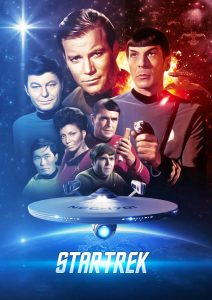
The cast of Star Trek circa 1967. L-R back row: De Forest Kelly (Dr. McCoy), William Shatner (Capt. Kirk, Leonard Nimitz (Spock) L-R front row: George Takei (Lt. Sulu), Nichelle Nichols (Lt. Uhura), James Doohan
(Lt. Commander Scott) and Walter Koenig (Ensign Chekhov).
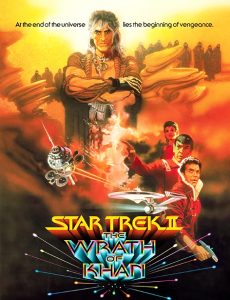
Theatrical movie poster from 1982’s “The Wrath of Khan.”