Native Tribes and the American Revolution
Part Nine of a Continuing Series
By Tom Madsen
“Wherever your armies go, there we will go: you shall always find us by your side; and if providence calls us to sacrifice our lives on the field of battle, we will fall where you fall, and lay our bones by yours.
We are determined never to be at peace with the Redcoats while they are at variance with you.
If we are conquered, our lands go with yours. But, if we are victorious, we hope you will help us to recover our rights.”
-Captain Solomon Uhhaunauwaunmut,
Chief Sachem of the Stockbridge Mohicans
at the Treaty of Albany, 1775
At the outbreak of hostilities between the British Empire and the American Colonies, many Americans would put everything they had, even their lives, on the line for independence, among them were numerous of the indigenous people of that part of North America. For decades, the Indian Tribes located in and around the thirteen colonies were torn between a British government that allowed some amount of autonomy and the colonists, who were seen by many as interlopers and a threat to their traditional way of life.
Since the end of the French and Indian War in 1763, many tribes had been living a fragile co-existence with the British Empire. Those who fought for the British were obviously treated much better than those who sided with the French. One of the results of the French and Indian War (which was a part of the much larger, worldwide Seven Years War) was the Proclamation of 1763, which essentially restricted British colonization of Indian land west of the Appalachian Mountains. This, of course, upset the colonies and became one of the factors leading to the American Revolution.
There had always been a rather unpredictable relationship between the Anglo Colonists and the Indian Tribes. While some from both sides went at lengths to coexist, cultural, economic, ethnic, political differences and, to some, fear hindered any kind of mutual understanding.
When the Revolutionary War began most of the tribes in North America supported the British. There were, however, some exceptions.
One of the most notable was the Stockbridge Tribe of Western Massachusetts. Organized in 1774, as the Stockbridge Militia and led by Jehoiakim Mtohksin and Abraham Nimham, it was the first native unit to fight for the American cause and declared their loyalty to the colonists.
The Stockbridge Militia participated in the Siege of Boston and the capture of Fort Ticonderoga in 1775. After Ticonderoga, the militia was disbanded. While some went home, others stayed and continued to fight for the colonists. By 1777, a new Stockbridge militia was organized and joined with the 8th Massachusetts Regiment, which made them an official part of the Continental Army. They continued to be commanded by Jehoiakim Mtohksin and Abraham Nimham. From 1777 to 1778 they partook in the Siege of Ticonderoga, when the British under General John Burgoyne, recaptured the fort, and the Battle of Saratoga in New York and the Battle of Monmouth in New Jersey.
On August 31, 1778, forty natives, including twelve members of the Stockbridge Militia, were ambushed and killed by a British unit known as the Queen’s Rangers. Abraham Nimham and his father, Daniel were two of the Stockbridge killed in that ambush.
After the ambush, Hessian captain Johann Von Ewald sketched a picture based on one of the dead Stockbridge soldiers. To this day, it is the only depiction of a 1770’s Stockbridge Militia soldier. He described them this way:
“Their costume was a shirt of course linen down to the knees, long trousers also of linen down to their feet, on which they wore shoes of deerskin, and the head was covered with a hat made of bast. Their weapons were a rifle or musket, a quiver with some twenty arrows, and a short battle-axe, which they know how to throw very skillfully. Through the nose and in the ears they wore rings, and on their heads only the hair of the crown remained standing in a circle the size of a dollar-piece, the remainder being shaved bare. They pull out with pincers all the hairs of the beard as well as those on all parts of the body.”
The ambush was the last engagement of the Stockbridge Militia. The survivors requested a leave to assist the families of those killed. General George Washington gave the order for discharge and issued the militia $1,000.00 for their service in late 1778.
Most of the survivors eventually settled in Oneida, New York and, years later, were moved to Wisconsin as the Stockbridge-Munsee Tribe of Mohican Indians.
In December of 1777, General Washington moved his army to Valley Forge in Pennsylvania, as their winter headquarters, about twenty miles from Philadelphia and the British encampment. Staying in crude, rundown log cabins, the Continental Army had very little food, medicine or clothing. Desertions and death were rampant. Then, a group of Oneida Indians from New York, members of the famed Iroquois Confederation and allies of the Colonials, came into camp with food and supplies. Most of what they had was white corn, which could not be prepared like the more common yellow corn the Colonials were used to. Legend and Oneida oral tradition tells the story of a young Oneida woman by the name of Polly Cooper, who stayed throughout the winter to teach the Colonials how to prepare white corn and to assist them in any way possible. The Oneidas and in particular, Polly Cooper, and their acts of bravery and generosity helped the Continental Army survive that horrible winter.
The most famous group of natives and those who lost the most during the American Revolution was the Iroquois Confederation, made up of six northeast tribes (Mohawk, Oneida, Onondaga, Cayuga, Seneca and the Tuscarora) in current day New York State that banded together for mutual protection. One of their basic decrees was that no tribe within the Confederation would fight another. This ended with the Revolutionary War.
Both British and Americans wanted Confederation support. In 1777, the British met with the Iroquois in Oswego, New York and asked the tribes to align with them and go to war against the colonials. While some were in favor, most of the leadership felt the conflict was a “family quarrel among Europeans” and thought involvement would be a mistake. The Americans also tried to convince the Confederation to join their cause, but, once again, the Iroquois leadership was cautious.
Eventually they did join in the war, which divided the Confederation, and eventually led to its demise. The split was exemplified at the Battle of Oriskany in 1777 when pro-British and pro-American Iroquois fought one another. Siding with the British were the Seneca, Cayuga, Onondaga and the Mohawk. The Tuscarora and the Oneidas sided with the Americans.
After hostilities had ended and the peace treaty between the British and the Anglo Americans was signed in Paris in 1783, nothing was done to provide post war assistance to the Indian allies on either side. In 1784, the Iroquois Confederation was forced into signing a separate treaty with the United States. The treaty called for those Confederation tribes who supported the British to give up large portions of their land. As a result, most of them ultimately moved to Canada. Revolutionary allies, the Tuscarora and the Oneida received very little in compensation from the new government. Eventually, a faction of the Oneida Tribe was sent to Wisconsin.
As a result of the American Revolution and other factors throughout the decades, the United States ultimately became the most powerful nation on Earth. Yet, when there is greatness, there is also great error. The fledgling American government failed in its relations with the indigenous people of North America, as it did with the newly freed African slaves after the Civil War of the 1860s, and others from around the world, who came to America for a better chance at life, which made the United States a vanguard of freedom to the rest of the world. In hindsight, however, all people who wanted to live in America could have and should have been treated fairly and with compassion. We failed in that regard, and unfortunately continue to do so today.
While we cannot change the past, we, as a nation, one nation, can certainly look to the here and now to heal age-old wounds. Especially within our own continent and the peoples that have lived here long before our ancestors set foot on this ground.
E pluribus unum – “out of many, one”
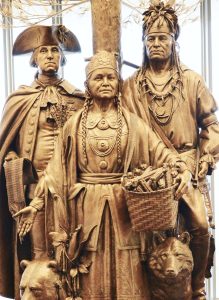
A 2004 sculpture by Edward E. Hlavka titled “Allies in War, Partners in Peace.” With General George Washington (L), Oneida’s Polly Cooper (Center) and Oneida diplomat Oskanondonha commemorating the aid the Oneida community gave to Washington’s army during the winter of 1777-78 at Valley Forge.
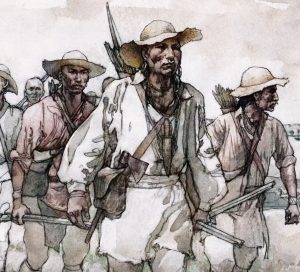
A 20th century study of Stockbridge Indians
during the American Revolution.
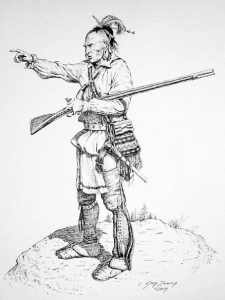
Modern day artist Gary S. Zaboly’s rendition of a Stockbridge scout for Roger’s Ranger Corps during the French and Indian War circa 1756-1759.
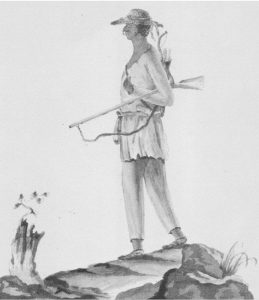
Believed to be the drawing from Hessian captain Johann Von Ewald describing what the Stockbridge Militia looked like during the American Revolution.