The Committee of Five
Part Ten in a Continuing Series
By Tom Madsen
“Resolved that these United Colonies are, and of right ought to be, free and independent States, that they are absolved from all allegiance to the British Crown, and that all political connection between them and the State of Great Britain is, and ought to be, totally dissolved.”
– A portion of Virginia’s Resolution on independency, presented to the Second Continental Congress on
June 7, 1776
Thus, the resolution, brought forth by Virginia delegate, Richard Henry Lee, declaring to King George III and the British Parliament that the American Colonies, in accordance with the “laws of nature,” should be “free and independent states.” Four days later on June 11, 1776, the Continental Congress appointed, again by resolution, an ad hoc committee to write a list of grievances against Great Britain. That resolution said, in part, “That the committee, for preparing the declaration, consist of five; the members chosen, Mr. Jefferson, Mr. J. Adams, Mr. Franklin, Mr. Sherman and Mr. R.R. Livingston.”
Every school kid in the United States is taught at an early age that Thomas Jefferson was the author of the Declaration of Independence. Some may remember colonial stalwarts John Adams and Benjamin Franklin also took part. But there were two others history sort of diminished: Robert Livingston from New York and Roger Sherman from Connecticut. They would round out what would eventually be called the “Committee of Five.”
Adams, Franklin and Jefferson are household names and will forever be remembered in the forefront of the patriotic leadership that chose to publicly thumb their noses at the world’s most powerful empire. Adams and Jefferson were future presidents of the young republic and Franklin would be remembered for many of the new gadgets, publications or witticisms from that era, let alone his diplomatic prowess and almost sage like presence during the early years of the American Revolution and its aftermath.
So, what about Livingston and Sherman? While not as well-known as the others and apparently did not offer much in regard to the actual writing of the Declaration document, they were still very important in the cause of American independence.
Robert R. Livingston, the eldest child of Judge Robert Livingston and Margaret Beekman Livingston was born on November 27, 1746 in New York City. Both of his parents were from wealthy and influential Hudson River Valley families and while his brothers and sisters remained close to the family estate called Clermont Manor, Robert pursued a career in the early days of American government.
He graduated from King’s College (now Columbia University in New York City) in June of 1765 and was admitted to the bar in 1770. In that same year, he married Mary Stevens, the daughter of Continental Congressman John Stevens.
In October of 1773, Livingston was appointed the Recorder of New York City, but was eventually replaced due to political reasons. Two years later he was elected to the Second Continental Congress.
Roger Sherman was the second of seven children born into the farm family of William and Mehetabel Sherman on April 19, 1721, in Newton, Massachusetts. He has the distinction of being the only person to sign all four of the documents that formed the early United States government: the Continental Association, the Declaration of Independence, the Articles of Confederation and the United States Constitution.
In 1743, after his father’s death, the Sherman family moved to New Milford, Connecticut; soon thereafter Roger and his brother William opened the town’s first store. Within two years, Roger would find himself one of the leading citizens of New Milford, eventually becoming the town clerk and the county’s surveyor. He also studied law and was admitted to the bar in 1754. He took an interest in public affairs and served in the Connecticut legislature from 1755 to 1766. He, like Livingston, was elected to the Second Continental Congress in 1775.
The Committee of Five was formed to determine how this declaration would or should be written. The committee, in true democratic fashion, voted on whom would have the “honor” of putting into words what Richard Henry Lee proposed. Thomas Jefferson came in first, while John Adams was second. Uncharacteristically, Adams knew his limitations and encouraged the thirty-three-year-old Jefferson to author the declaration in a (as usual) written memo:
“Reason first – You are a Virginian, and a Virginian ought to appear at the head of this business. Reason second – I am obnoxious, suspected and unpopular. You are very much otherwise. Reason third – You can write ten times better than I can.”
Now, John Adams was many things, but humble he was not. For him to admit, much less write it down for prosperity, that young Jefferson (Adams was eight years his senior) could write “ten times better” than Adams was remarkable in itself!
Jefferson came to the Second Continental Congress with a “reputation for literature, science, and a happy talent of composition,” which made his writing style “remarkable for the peculiar felicity of expression.” He would be charged to put into words the meaning of Lee’s resolution. After seventeen days, a couple of meetings with Adams and Franklin for preliminary readings and corrections, Jefferson completed his rough draft. Later, he noted he wrote it in “terms so plain and firm, as to command assent.” He drew much of his inspiration from George Mason’s “Virginia Declaration of Rights” and, as he wrote later, the writings of “Locke, Montesquieu, the Scottish Enlightenment, and the long struggle for English civil liberties.”
On June 27, Jefferson’s completed draft was presented to the rest of the Committee of Five for a final reading before it would go before the Congress. According to a letter Adams wrote to Timothy Pickering in 1822, four years before his death:
“We reported it to the committee of five. It was read, and I do not remember that Franklin or Sherman criticized anything. We were all in haste (to get it to Congress).” According to most historians, “neither Sherman nor Livingston made any changes in the draft.”
There would be three “stages” to Jefferson’s declaration: the preamble, which is (and continues to be), in a sense, political poetry (“When in the Course of human events, it becomes necessary for one people to dissolve the political bands which have connected them with another…”), which in time would become the heart of the document. Then, Jefferson listed a number of grievances against King George III. The third and final “stage” declared the Colonies right to be an independent nation.
The next day, the “rough draught” (Jefferson’s spelling) was submitted to the Congress, although, they would not meet until July 1. On July 2, Congress adopted Lee’s resolution by a vote of 12 to 0 with one colony (New York) abstaining. Then, they began making revisions to the declaration, including the removal of the section condemning slavery. After the alterations were made, Congress voted to adopt the Declaration of Independence on July 4, 1776.
The British American Colonies were now the self-declared, United States of America.
Even with the Declaration being approved, the Committee of Five still had work to do. Congress directed the Committee to oversee the printing of the document. The first copies were from the shop of John Dunlap, the official printer of the Continental Congress. Over the night of July 4 and 5, Dunlap printed enough copies for the members of Congress, various committees and assemblies and to the field commanders of the Continental Army – including George Washington, who had the document read to his troops on July 9, 1776.
Just before the Declaration was to be debated and voted, opposition leader John Dickinson, a delegate from Pennsylvania, metaphorically stated the American Colonies were about “to brave the storm in a skiff made of paper.” The “storm” would be the upcoming revolution and the “skiff of paper” was the written document declaring the reasons for rebellion.
This so-called “American Experiment,” which we have declared, developed and nurtured over the past two and a half centuries, began with an assortment of men, all from varying professions, educations and locations, appointed to declare before the nations of the world a written document explaining the reasons for cutting the bonds of their mother country. Nothing like that had ever been done before.
For two hundred and fifty years we have struggled to maintain this fragile republic through cultural, economic and militaristic chaos and revolution. At times, we were our own worst enemy, but we have always found a way out of our troubles. Some call it “providential foresight,” while others “The American Way,” even the rather pompous, “Manifest Destiny,” suggesting an ecclesiastical calling. Whatever one calls our founding and the fact that we have survived this long, and considering our own rather chaotic nature, we continue to be the envy of both our allies and our enemies.
It began on a hot, humid day in Philadelphia and through decades of trials, setbacks and quandaries, we have survived to be the longest standing representative democracy in the history of the world, and it started with a Committee of Five.
“We hold these truths to be self-evident, that all men are created equal, that they are endowed by their Creator with certain unalienable Rights, that among these are Life, Liberty and the pursuit of Happiness.”
Amen.
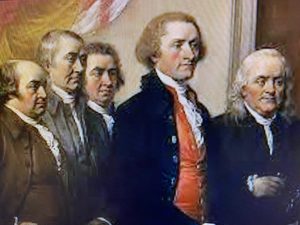
A close up of John Trumbull’s 1818, classic, but historically incorrect painting, “The Declaration of Independence.” L-R: John Adams, Roger Sherman, Robert Livingston, Thomas Jefferson and Benjamin Franklin presenting the finished Declaration of Independence to the Second Continental Congress.
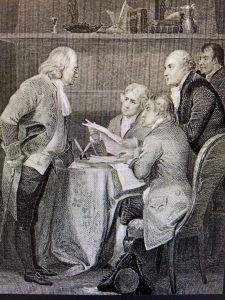
What seems to be a pencil drawing of the Committee of Five. The artist and the date of the drawing are unknown. There is, however, a colored version hung in the New York Public Library.