America’s First Government: The Articles Of Confederation
Part Eleven in a Series
By Tom Madsen
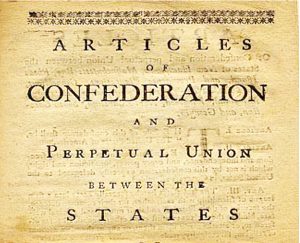
“To all to whom these Presents shall come, we the undersigned Delegates of the States affixed to our Names send greeting. Articles of Confederation and perpetual Union between the states of New Hampshire, Massachusetts-bay Rhode Island and Providence Plantations, Connecticut, New York, New Jersey, Pennsylvania, Delaware, Maryland, Virginia, North Carolina, South Carolina and Georgia. Article 1 The Stile of this Confederacy shall be ‘The United States of America.’”
-written by Benjamin Franklin on or around June 12, 1776.
On June 12, 1776, one day after the Second Continental Congress formed the Declaration Committee, which would put into writing a document to King George III, revealing their intention of seeking independence from Great Britain, they formed another committee that would be called upon to develop a system of government for the soon to be declared sovereign United States of America. These governmental by-laws would eventually be called the Articles of Confederation. The members of the committee would be made up of representatives from each of the thirteen colonies. Then, that committee would appoint a select committee of five men who would actually plan and develop the proposed form of government. Two of the five were already on the Declaration Committee and its eventual chairman was one of the more vocal anti-independency members of Congress. Those members were John Dickinson and Benjamin Franklin from Pennsylvania, John Adams from Massachusetts, Robert Morris from New York and Benjamin Harrison from Virginia.
Dickinson, while supporting independence if it were given, was a strident opponent of taking independence, while both Adams and Franklin were members of the committee that would eventually write the declaration. Morris was from the state that initially abstained from voting for independence due to a lack of communication between the colonial assembly and its congressional delegation. Harrison, the least controversial of the five, would be the father of the nation’s ninth president, William Henry Harrison and the great grandfather of the 23rd president, his namesake, Benjamin Harrison.
The Articles of Confederation were worked on by the committee from June of 1776 to November of 1777, when it was completed, passed by the United States Congress (the term Continental was dropped once independence was declared) and sent to the states for ratification. Virginia was the first to ratify on December 16, 1777.
So, what exactly were the Articles of Confederation and why did these “articles” eventually succumb to the more extensive United States Constitution?
To begin, the Articles were more like a treaty between the states than a binding constitution. Within the Articles, each state retained its own “sovereignty, freedom, and independence […], jurisdiction and right, which is not by this confederation expressly delegated to the United States ….” In other words, the states were their own individual powers within themselves and the “national” government represented by Congress, would have limited authority over the states. In an article written in the Gilder Lehrman Institute of American History, under the Articles of Confederation, “…Congress (was) the primary organ of the new national government, (but) only had power to declare war, appoint military officers, sign treaties, make alliances, appoint foreign ambassadors, and manage relations with American Indians.” There would be no supervision over interstate travel or trade. There was no congressional representation by population as each state was equally represented in the Congress with one vote. To pass legislation, nine states had to vote to approve any measure to become law. To amend a law, all states had to be in agreement. The Congress could not tax as that was left up to the states and if Congress wanted money, they had to ask the states, borrow from foreign countries or sell western lands. There was only one house in the legislature and there were no judicial or executive branches in the national government.
The Articles of Confederation was an attempt by the fledgling United States to balance the power of the states with an effective and small national government. For instance, under the Articles, Congress had no power to raise an army or to regulate trade. That was left to each individual and sovereign state.
The Articles did not promote the idea of true republicanism. Nationally, power was centered in the Confederation Congress with no other branch to check its authority. Also, the thirteen members of the Confederation Congress were appointed by their state governments and not publicly elected.
One of the key issues during the development of the Articles of Confederation, aside, of course, the war for independence, was the issue of the western lands of the colonies. Many of the larger states had claims to that land, while the smaller states complained the larger states were stunting their growth. In particular three states, New Jersey, Maryland and Delaware refused to ratify the Articles until the western land issue was solved. In hindsight, this had to be a most frustrating circumstance. The Revolution was not going well for the Colonists as the British continued to chase General Washington’s army from New York to Virginia, while Congress was also running; moving the capital from Philadelphia to Maryland. One has to wonder what compelled those delegates to be more concerned about land when they hadn’t been able to stop British advancements. The colonies declared their independence, but were nowhere near an actual governmental structure, aside from Congress, yet, they worried about what state was going to get what land.
Be that as it may, the western lands were an issue and eventually New Jersey and Delaware were satisfied and voted to ratify the Articles in November of 1778 and February of 1779, respectively. Maryland was the last holdout. Unwittingly, the British assisted in convincing Maryland to finally ratify and join the Confederation. In 1780, the British raided several Maryland communities around Chesapeake Bay, prompting Maryland to seek assistance from the French Navy. French minister Anne-Cesar De la Luzerne wrote back to the Marylanders that they would assist, only if the state would ratify the Articles of Confederation. To help convince Maryland, Virginia then agreed to abandon claims of land in the west. That satisfied Maryland as they became the last state to ratify the Articles on March 1, 1781.
The United States had a government. The next question: what to do with it?
The Articles of Confederation, a “League of Friendship” between the states was an attempt to organize a government without a strong central authority like that of the British Empire. Most of the power was held by the states and the only feature of a central government was a rather weak and limited legislature. After independence was won, it did not take long for the leaders of the United States to realize the potential disaster that was awaiting the soon-to-be-tested Articles of Confederation.
First there was no regulation in regard to trade and the kind of currency each state would have. There was no executive to make real governmental decisions and there was no central court system to hear grievances between the states. Most importantly, there was no standing Army, as the British were still in Canada, waiting patiently for the Americans to fail.
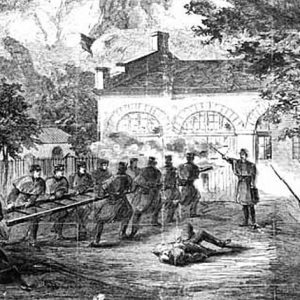
That issue came to a head in 1786, when the country was thrown into an economic depression, which was particularly hard on the debt-ridden states. As a result of the tough economic times, groups of citizens from New Hampshire to the Carolinas took up arms in protest over a lack of action by the state governments to relieve them during the financial crisis. The most serious threat to the new government came from Massachusetts, the birthplace of the American Revolution. Led by Daniel Shays, a former captain in the Continental Army, the rebels attacked and attempted to capture a federal arsenal at Springfield, Massachusetts. While Shays’ army was not very large and did not do a lot of damage, the principal question was, whose responsibility was it to put down the revolt? The rebels attacked an arsenal belonging to the federal government; yet, there was no federal army. After some arguing and wrangling, the state militia under the command of General Benjamin Lincoln, crushed the rebels on several occasions and eventually drove Shays and many of his followers to Vermont.
The revolt took place in Massachusetts and the rebels attacked a federal facility. Who was supposed to cover it? As small as Shays’ Rebellion was, it did expose a simple, yet glaring problem within the Articles of Confederation, “who’s in charge?”
The Articles of Confederation was an attempt to establish a government that would be, in a sense, anti-government, especially a central government, much like the one in Great Britain the Americans just rebelled against. However, this “firm league of friendship” was ill-equipped to withstand any of the perils that would follow the birth of a young and inexperienced nation.
Even as the leaders of the new country realized the Articles of Confederation were not what they had hoped for, it did accomplish some things, especially with regard to land surveying and ownership, that had far-reaching ramifications as the United States expanded westward during the next century. The Northwest Ordinance of 1787 was in part an agreement among the original states that laid the groundwork for new states in what was then called the Northwest Territory, which would eventually become the states of Ohio, Indiana, Illinois, Michigan and Wisconsin. Also, under the Articles, the Northwest Ordinance made significant advances toward the abolition of slavery, as these territories would all be considered free states.
By January of 1786, most of the nation’s leadership knew the Articles would not be able to inspire the growth the new government needed. On January 21, Virginia invited the other states to come to Annapolis, Maryland to discuss ways to decrease the animosities between the states. Not all states came, but for those in attendance, it was eventually decided the states should meet in Philadelphia in May of 1787 to amend the Articles of Confederation in what was first called the “Grand Convention.” It would eventually turn into a “Constitutional Convention” chaired by George Washington, whose outcome would be the document we hold so dearly today.
So, after all is said and done, was there a benefit derived from the Articles of Confederation? Well, for starters, it kept the thirteen original states together in a loose coalition while the nation went through its growing pains. It gave some semblance of order amid the chaos of the early days of the neophyte government and, even by its failures, and there were many, it laid the groundwork for the republic we have today.
Every living thing has to experience growing pains as it matures. The same can be said for a government, which, in a sense, is a living, breathing organism. The Articles of Confederation, with its many flaws, was the gatekeeper to our fragile selves as we grew and developed into what we needed as a governmental entity, and as a people. A supreme law of the land – a constitution.