The Second Term Curse
The Second Term Curse:
The Problems of Second Term Presidencies
Part One in a Series
By Tom Madsen
As we approach the second and final mid-term election of President Donald Trump’s two non-consecutive terms in office (Grover Cleveland was the only other president to serve two non-consecutive terms: 1885-1889 & 1893-1897), his second term has been, to say the least, controversial. We are seven months into a war with Iran being fought, as claimed by his administration, to eradicate Iran’s nuclear weapons program (which, in reality does not exist). The Obama administration (along with six other nations and the European Union) had reached a non-nuclear armament deal with Iran eleven years ago. The estimated cost of this war is between $66 and $100 million a day, which has a direct bearing on the current economic inflation.
He’s insisting on changing the landscape of Washington through several questionable renovation and construction projects, including the destruction of the East Wing of the White House complex and replace it with a “secured” ballroom; and the proposed construction of a gaudy “Arch de Triumph”, which would overshadow the Lincoln Memorial and the Arlington National Cemetery. Now he’s saying if his name isn’t on the Kennedy Center for Performing Arts, he will “rip it down.”
He arbitrarily has renamed at least two geographical sites that were named before the United States was in existence.
And, the Epstein “issue” continues to linger.
We should not be surprised.
*****
The United States has re-elected presidents to a second term twenty-two times. Almost all of re-elected presidents, faced some form of scandal (usually self-inflicted), foreign policy fiasco or some other financial/political calamity during their second-term. With just months away from the beginning of President Trump’s final two years of his second term, we’re going to take a look at some of the “issues” faced by other “modern day” second-term presidents.
We will begin with Franklin Roosevelt (1933-1945), Harry Truman (1949-1953) and Dwight Eisenhower (1957-1961).
*****
No presidency has been as consequential as Franklin Roosevelt’s. Yet, his second term (1937-1941) showed cracks in his leadership and his signature New Deal. These ambitious and groundbreaking programs were developed to combat the devastation brought on by the Great Depression (1929-1939). Yet, its success was stymied by several Supreme Court rulings claiming the programs were unconstitutional. The New Deal was an “alphabet soup” of social programs developed to assist those who were suffering most from the Depression. Its innovative programs included job training, infrastructure, and safety networks to protect those who could not help themselves. One of the most notable, which continues today was Social Security.
The Supreme Court, of whom all but two were appointed by Republican presidents, began striking down some of FDR’s New Deal laws soon after he took office. For the next thirteen months, the Court rejected more pieces of legislation than at any time in the nation’s history.
Roosevelt was overwhelmingly re-elected in 1936. He was riding a crest of popularity and legislative victories, but was frustrated by the Supreme Court’s rejection of his New Deal programs. He had to find a way to counter the conservative Court.
After his second inauguration, his administration proposed the “Judicial Procedures Reform Bill of 1937.” Republicans and Democrats alike saw right through it, as the proposed legislation was soon labeled a “court-packing plan.” The bill would allow the president to appoint up to six additional justices to the Supreme Court for every justice older than seventy years and six months and sat on the Court ten years or more. It was an absurd plan and was unpopular across the board. As good as FDR was at reading political tea leaves, he mistook his resounding electoral victory as a mandate to govern essentially as he pleased. The doomed bill never made it to a vote and died in committee. Still the damage was done and the minority Republicans in Congress felt emboldened (to a point) and began to question more of FDR’s policy proposals.
Franklin Roosevelt was elected to four terms and served just over three. He died four months into his fourth term and is considered today to be one of our most effective and greatest presidents. Yet, his second term, which included other missteps by his administration, will forever be remembered when his presidency stepped out of the political bounds of the day.
*****
When FDR died unexpectedly on April 12, 1945, his vice president, Harry Truman, was thrust into office during one of the most trying times in history. Not only was Roosevelt an incredibly popular president (which made it very difficult for anyone to replace him, much less a plain-spoken, little-known former senator from Missouri), the war in Europe was coming to a close, while the war in the Pacific had no end in sight. Truman and Roosevelt met privately only twice since taking office in January of 1945. It was obvious the vice president was not part of FDR’s inner circle and was not included in almost every major policy decision. Still, once in office, his leadership at the Potsdam Conference between the U.S., the Soviet Union and Great Britain, brought opposing ideologies closer together to map out post-war Europe and he had the “controversial” courage to use atomic weapons to bring a close to the war in the Pacific.
Truman was elected in his own right in 1948, after it was widely speculated he would be soundly defeated by Republican New York Governor Thomas Dewey. Truman served three years and eight months of FDR’s final term, so, for all intents and purposes, the election of 1948 would mark the beginning of his second term in office.
Truman’s second term, while successful on many fronts, including the Marshall Plan, which provided $13 billion in American aid to help rebuild seventeen Western and Southern European economies after World War II, was mired with one problem after another:
* Red China: The loss of China to the communist regime of Mao Zedong (1949).
* Nuclear Russia: The Soviet Union detonated its first nuclear device, which led to the arms race that continues today.
* The Korean War: North Korea, assisted by Red China, invaded South Korea, forcing the United States to commit thousands of troops, which resulted in massive casualties and a stalemate that is still in effect.
* Fair Deal Obstruction: Truman’s version of FDR’s New Deal was the Fair Deal. With emboldened Republican majorities in both houses of Congress, Truman’s domestic agenda, which included national health insurance, civil rights protections and the repeal of the anti-union Taft-Hartley Act stymied any attempt at augmenting FDR’s domestic policies.
* McCarthyism and the Red Scare: Fronted by Wisconsin Senator Joseph McCarthy’s claim that Communists had infiltrated the State Department, which led to a widespread conspiracy that “Reds” had penetrated many characteristics in American life, especially the military and the arts/motion picture industries. While Truman was not supportive of McCarthy’s methods, he did little to stop it.
* Southeast Asia: The Truman administration began the covert activities that eventually led to the disastrous Vietnam War.
Truman did not have the outgoing personality or the sophisticated speaking style of FDR. He came across as hesitant and stumbled over wording. It got to the point where he was called “Hapless Harry” by the conservative press. His popularity plummeted to 22% by 1952, essentially ending any thought of his running for another term.
The country had twenty years of two Democratic presidencies and toward the end of Truman’s second term were suffering what could be described as “Truman Fatigue.” Investigators were finding bribery and ethical lapses among mid-level officials within the Truman administration and there appeared to be a general malaise throughout the country. It was time for change.
That change would come from the architect of D-Day and first-time Republican, General Dwight David Eisenhower.
*****
Eisenhower was swept into office in 1952 by defeating Illinois Governor Adlai Stevenson. It was never close. Ike carried thirty-nine states to Stevenson’s 9 and won the Electoral vote by 442 to 89.
After twenty years of Democratic rule, Eisenhower was a welcomed relief to the public. The World War II hero brought a much-needed calming effect to the national government. The economy was sound and America was at peace (relatively speaking). Americans were enjoying for the first time since October of 1929, a certain amount of prosperity.
The election of 1956 echoed the people’s satisfaction with the Eisenhower presidency as he won forty-one states to Stevenson’s 7, and garnered 457 electoral votes to 73 (one elector from Alabama did not vote for Stevenson). Everything was looking great for the president and the country.
Then came Ike’s second term.
The 1950s has a latter-day image of a rather laidback decade, where America appeared at peace with itself. We enjoyed the new musical phenomenon called rock and roll, people were working, industry was booming; the United States was the leader of the free world and on sound sociological, economic and political ground – at least on the surface.
Then came:
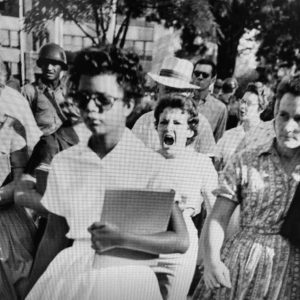
* The Little Rock Integration Crisis: On September 4, 1957, Arkansas Governor Orval Faubus deployed National Guard troops to block black students from entering Little Rock’s Central High School countering the landmark Supreme Court ruling, Brown vs The Board of Education, eliminating segregation by race. Eisenhower, at first was hesitant, but finally countered Faubus by federalizing the same Arkansas National Guard and ordering them to support the black students. He then sent in the 101 Airborne Division to assist the National Guard. While it was a positive move on Eisenhower’s part, it once again showed America’s deep and still unresolved problem: equality and civil rights for all citizens.
* Sputnik: In October of 1957, the Soviet Union launched the unmanned Sputnik satellite, which triggered fears the Soviets may be advancing faster than America in what was to become “The Space Race.”
* The Suez Crisis: In 1957, after the Anglo-French-Israeli invasion of Egypt, Eisenhower issued his doctrine offering American military aid against communist advances in the Middle East, which broadened U.S. involvement in that part of the world and created a continuing Arab mistrust of the Western powers.
* Recession of 1958: In the midst of a healthy economy, a sharp downturn hit industrial output and employment, indicating the American economy may not have been as robust as earlier thought.
* Ike’s Health Concerns: Eisenhower suffered a heart attack in 1955 which raised concerns about his overall health. In 1956 he had ileitis, which is the inflammation of the ileum, the final section of the small intestine. His age and his health became an issue.
Eisenhower completed his second term as the oldest man to hold the presidency up to that time. Coincidentally, he was replaced by the youngest man to be elected president.
The era historian William E. Leuchtenburg called “The Troubled Feast” was about to begin.
End of Part One.
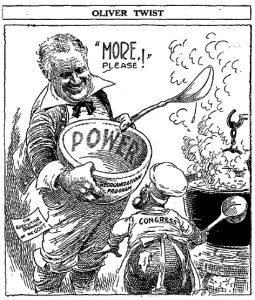
An editorial cartoon criticizing Franklin Roosevelt’s perceived desire to increase his political power after his resounding re-election in 1936.
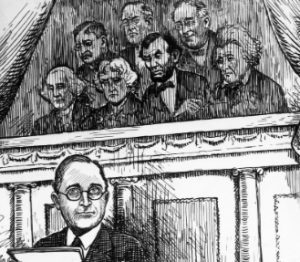
Political cartoon signifying the troubles Harry Truman experienced in his second term as he was being haunted by past presidents.
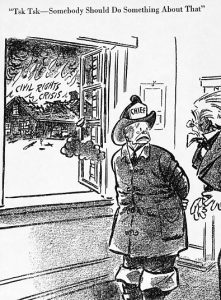
A Herblock cartoon criticizing President Eisenhower’s initial lack of leadership during
the Little Rock Integration Crisis of 1957.