September 2, 1963: George Wallace, Integration and the Tuskegee High School
By Tom Madsen
“If we can organize the Southern States for massive resistance to this order, I think that in time the rest of the country will realize that racial integration is not going to be accomplished in the South.”
-West Virginia Representative and former Ku Klux Klan member Robert Byrd
What U.S. Congressman (and future Democratic Senator) Robert Byrd declared in 1956 was essentially the deep-seeded belief in the South that the Supreme Court’s 1954 Brown vs the Board of Education ruling eliminating the constitutionality of racial separation would not succeed in the former Confederacy due to “massive resistance” and eventually die out. At least, in the South.
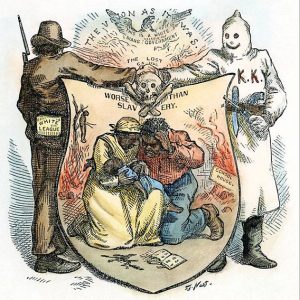
While there were many politicians in the South who wanted to be the standard bearer for segregation, very few exemplified these age-old and narrow-minded opinions more than Governor George Wallace of Alabama. At his first inauguration in January of 1963, he famously declared, “Segregation today! Segregation Tomorrow! Segregation Forever!”, laying the groundwork that would polarize the country for decades to come.
The diminutive, yet boisterous Wallace became the face of Southern resistance to the federal government’s order for all schools, especially in the South, to desegregate and ensure equal educational opportunities for all students.
Still, it would be another year; the assassination of a president; the political skills of the new president, the leadership of the anti-segregation movement and a coalition of moderate Republicans and liberal Democrats to enact legislation to end institutional segregation. It was called the Civil Rights Act of 1964.
Even while the United States Supreme Court ruled “separate but equal” in educational facilities unconstitutional, states in the South remained committed to defy the Court’s order by taking at first a rather laissez-faire attitude toward enforcement of that ruling. Then, as the courts began ordering schools to desegregate, political leadership in the South, as well as other regions, used the controversial rulings as a tool to provoke their citizens to protest and to go so far as to incite violence, even murder to protect their primordial way of life. While there were others who vilified desegregation, it was George Corley Wallace who became the face and the name of southern resistance, especially in June of 1963 when he personally blocked black students from entering the University of Alabama by standing in its doorway. He eventually yielded to the Kennedy administration when confronted by federalized National Guardsmen. Still, his reputation as a “fighter” for states’ rights and the continuation of segregation was solidified.
That resistance was further enhanced on September 2, 1963 at the Tuskegee High School in Macon County, Alabama.
In January of 1963, Montgomery, Alabama civil rights lawyer Fred Gray filed Lee v. Macon County Board of Education (the “Lee” in this case was Anthony and Henry Lee, two black teenagers) to force the all-white Tuskegee High School to allow fourteen African American students to enroll. United States District Judge Frank M. Johnson, Jr. granted Gray’s petition in July.
On September 2, the day the Tuskegee High School was to start classes, Wallace, by executive order, shut the school down for a week and ordered hundreds of Alabama State Police to enforce his directive.
Within days, Judge Johnson and an ad-hoc group of five other federal judges issued a temporary restraining order preventing Wallace from interfering with the desegregation not only in the Tuskegee school, but high schools in Birmingham and Mobile, which followed Wallace’s lead and were closed by local authorities. Wallace tried to sidestep the order by having the Alabama National Guard place troops around the schools to stop any of the black students from entering. When advised of Wallace’s actions, President John F. Kennedy federalized the Alabama National Guard and ordered them to stand down and return to their armories.
Wallace, however, was not one to graciously step aside; he then declared the State of Alabama would reimburse parents who chose to send their children to a newly opened all-white private school or to an all-white public school in another district. On September 9, when the Tuskegee High School finally opened for the fall semester, the only students to attend were from the African American community. All 275 white students stayed home. Wallace then ordered the school closed, which left the black students only two options, attend the all-black Tuskegee Institute High School or seek schooling in some other district.
Judge Johnson, however, was not through playing this cat and mouse game with the governor. Joined by two other federal judges, he ordered the state to bus the African American students to the all-white public schools and forbade the state from paying for white students to attend private schools outside of their district. Johnson also ruled that due to Wallace’s actions as of September 2, there was sufficient evidence state officials were controlling public education and not local authorities. Johnson could then issue permanent desegregation orders as part of his ruling in Lee v. the Macon County Board of Education.
While the district court and the federal government won a significant victory over the forces of discrimination, George Wallace would continue his personal crusade against integration, not only in the South, but nationwide. He went on to become the face of white segregationist protest in America.
In 1964, feeling emboldened from his battles with the federal government, Wallace decided to run against President Lyndon Johnson in three of the sixteen Democratic presidential primaries, using the pending Civil Rights Act of 1964, at that time making its way through Congress, as a catalyst to “rob hard working white Americans of their jobs, their neighborhoods, and their way of life.” Even while none of those claims had merit, it hit a chord with certain white families.
The first primary Wallace entered was in Wisconsin. While Johnson was not officially on the ballot, Democratic Governor John Reynolds, who described the Alabama governor as “a kook,” ran as a “Favorite Son” (essentially a stand-in for another, undeclared candidate) for the president. The press and professional politicians did not take Wallace seriously. After the voting in Wisconsin, however, Wallace stunned the political world by receiving 266,000 votes, almost a third of the votes cast in the primary. He went on to draw a considerable number of votes in Indiana and almost won in Maryland, mainly because of his populist and racial rhetoric. The Democratic Party leadership and Lyndon Johnson were relieved when Wallace lost steam after the three primaries and essentially ended his campaign. While still a Democrat, he became an unwanted symbol for in the established party and seen as more of a nuisance than anything else. Never the less, he, in part, laid the groundwork for a fundamental philosophical shift within the Democratic Party, partially due to the Civil Rights Act of 1964 and the rhetoric of conservative Democrats like Wallace. Trade union, blue-collar, working-class white voters, long a major player in the Democrat’s structure, began drifting toward the Republican Party, which was trending toward the more reactionary, ultra-conservative policies of Senator Barry Goldwater (R-AZ), the eventual 1964 GOP presidential nominee.
In the 1964 presidential election, Johnson soundly defeated Goldwater. He carried only carry six states; five from the Deep South (Alabama, Mississippi, Georgia, Louisiana and South Carolina) and his home state of Arizona. Riding a crest of popularity, Johnson went on to steer the Voting Rights Act of 1965 through Congress, along with many Great Society financial and social programs, including Medicare and Medicaid. The unpopular war in Vietnam eroded much of Johnson’s “era of good feeling.” By early 1968, he declared he would not run for another term.
In 1968, Wallace ran for president as a third-party candidate under the banner of the American Independent Party, where he received 13% of the vote and carried five southern states (Alabama, Arkansas, Georgia, Louisiana and Mississippi) in a relatively close election between the two major party candidates, former Vice President Richard Nixon and Vice President Hubert Humphrey. Nixon won by just over 500,000 votes out of more than 72,000,000 cast. Over the next four years Wallace built a coalition to run in the Democratic primaries in 1972. While polling showed Wallace making inroads within the Democratic Party, his campaign ended, when he was shot in an assassination attempt by twenty-one-year-old Milwaukeean Arthur Bremer in Maryland on May 15, 1972, which left Wallace permanently paralyzed from the waist down.
While he was reelected to the governorship in 1974 and ran for the Democratic presidential nomination in 1976 as a “reformed” Southerner in favor of racial integration, he never regained the political status he had in the mid-to-late 1960s. Wallace retired at the end of his final term as governor in 1987. He died on September 13, 1998.
Even though George Wallace’s politics and political philosophy were offensive and eventually rejected by voters nationwide, he did, with his anti-integration, anti-governmental rhetoric, reveal an underlying weakness in the Democratic Party’s constituent coalition by catering to blue collar voters who, after the progressive policies of the Kennedy/Johnson administrations, felt the Democrats were drifting away from them. Richard Nixon’s 1968 “Southern Strategy”, solidified the Democrats loss of that key portion of their party. The “Southern Strategy” was used to expose the fear certain whites would have if minorities in America were to gain political power. It eventually led to electoral successes and the conservative presidencies of Ronald Reagan, both Bushes and, of late, Donald Trump and the MAGA movement.
What started as an attempt to slow down constitutionally given equality in America, ended up as part of a conservative movement, once held by the old Democratic Party of the South, but now firmly encased within the Republicans. And, that movement can be traced, in part, to that September day when an angry little man from Alabama tried to halt the rights of all American students to a free, equal and appropriate education.
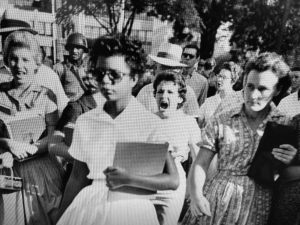
A mob of angry southern whites harassing a young black student as she enters Tuskegee High School.
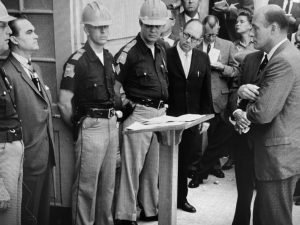
Governor George Wallace confronting deputy attorney general Nicholas Katzenbach during an educational stand off in Alabama.
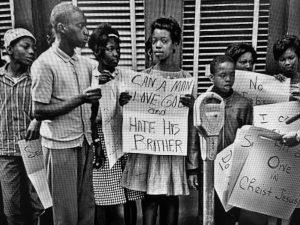
Young black students protesting the closing of the Tuskegee High School in September of 1963.