HOLLYWOOD VS. HISTORY “Guess Who’s Coming to Dinner”: A Case for Love
Part Twenty-nine in a Series
By Tom Madsen
“Guess Who’s Coming to Dinner’ is no less probing and powerful … a picture show now as it was then. Almost every scene stands out as important. It is sharp, biting … and continuously still radical in its comic and drama …”
-Writer Scott Holleran, 2016
Nineteen sixty-seven. A year that saw the overly hyped “Summer of Love” in San Francisco, riots in Watts and Harlem, an increase in America’s military presence in Vietnam, the innovative Sgt Pepper’s Lonely Hearts Club Band, Bobbie Gentry’s allegoric and mysterious “Ode to Billy Joe” (what were they throwing off the Tallahatchie Bridge?), the controversial March on the Pentagon (“Support Our GIs – Bring Them Home Now!”) as college campuses and inner cities became sites of unrest. If 1968 was a watershed year in American history, 1967 was its predecessor.
So, what about motion pictures?
In 1967, we witnessed some “beginnings” in the movie industry. For example, “Bonnie and Clyde” was hailed as a cutting-edge motion picture about love on the road, folksy people who killed and robbed in between social stops and during all this action, invoked a little humor. Yet the real claim to the movie’s celebrity was the level of gory violence that would end up sweeping Hollywood in the years to come. In reality, as much as critics liked “Bonnie and Clyde”, it was lousy history, as it was a motion picture.
But we digress.
Nineteen sixty-seven had a host of groundbreaking movies that tackled some of the more poignant issues of the day. “Cool Hand Luke”, starring Paul Newman in the title role, told the story of cultural, societal and generational differences in America as symbolized through a southern prison work camp (“What we got here, is failure to communicate!”).
“The Graduate”, Dustin Hoffman’s breakout film, dealt with the growing “generation gap” that was so prominent in the 1960s. And, the Academy Award winning, “In the Heat of the Night”, dealt with racial prejudices in the South.
In Mel Brooks’ directorial debut, “The Producers”, poked fun at Broadway musicals, with Zero Mostel as a crafty conman and a very young and nervously energetic Gene Wilder. Then, Hollywood took a mocking look at the ever-popular “secret agent” movies in “Casino Royale” featuring a retired, sophisticated and stammering James Bond, played by David Niven.
Then, there was “Guess Who’s Coming to Dinner”:
A fictional story about an interracial marriage was released on December 11, 1967 just five months after the Warren Court struck down anti-interracial marriage laws (primarily in the South) in the Loving v. Virginia decision.
Director Stanley Kramer, known for his “morality” movies, like “Inherit the Wind” and “Judgment at Nuremburg”, told the story of a young couple who met while vacationing in Hawaii, fell in love and 10 days later decided to visit the girl’s parents in San Francisco to tell them of their plans to marry.
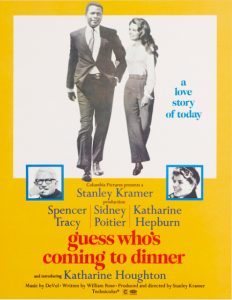
The parents, Matt and Christina Drayton, played by cinematic icons, Spencer Tracy and Katherine Hepburn, were wealthy (he, a newspaper publisher – she, a modern-day art dealer) “limousine liberals” (as were called in the ‘60s; today, they’re “Latte Liberals”) who had never faced a situation quite like what their 23-year-old daughter was going to spring on them.
The daughter, Joanna (Katharine Houghton), was bringing home a brilliant young doctor who had been working on treatments for tropical diseases in Africa and was on his way to the World Health Organization. His educational credentials included Yale and John Hopkins. On paper, everything looked great, but there was one problem, he was black.
The Drayton’s represented the attitude of many wealthy, white progressives of the 1960s; supporters of civil rights and racial equality, so long as it did not include any personal, long-lasting relationships.
And, therein lies the crux of the story. How do wealthy, established San Francisco liberals react when the Civil Rights Movement is planted in their living room? For the Drayton’s, not well.
The young doctor, a 37-year-old widower named John Prentice, played by Sidney Poitier, is described by film critic Roger Ebert as, “…noble, rich, intelligent, handsome (and) ethical…” He has everything wealthy, upper crust parents would want for their daughter – except for the color of his skin. Even if 1967 was a year the film industry began “pushing the envelope”, a storyline about interracial marriage was still contentious, even taboo. So much so, when Columbia Pictures was told of the film’s subject matter, they wanted to pull it from production. According to Katherine Houghton, “They kept saying, ‘Nobody’s going to ever come and see the film. We’re going to lose millions of dollars …”
Even with the controversial nature of the film, it still received criticism from a variety of corners. The liberal press said it didn’t go far enough, and some black journalists said Poitier’s depiction of the African American doctor was “too white, too perfect.” Also, some thought the supporting cast was too stereotypical. The Drayton’s black maid, played by Isabell Sanford, had been described as a bit too much like “Rochester” from the old “Jack Benny Show”, while their Catholic priest (Cecil Calloway), Matt’s golfing buddy and perceived alter ego, was described by Ebert as having a “brogue so fey and eyes so twinkling he makes Bing Crosby look like a Protestant.”
But even with those rather slight criticisms, “Guess Who’s Coming to Dinner” attacked head on not so much interracial relationships as it was back then, but the reaction of those closest to the young couple, especially Joanna’s father. Spencer Tracy’s depiction of Matt Drayton was a study in human emotions. While he could intellectualize the love his daughter had for Dr. Prentice, his innermost feelings were torn.
But Matt Drayton was not alone. His counterpart, John’s father, known only in the movie as Mr. Prentice (Roy E. Glenn, Sr.), was also against the nuptials. Both fathers had to grapple with their feelings over their children marrying out of their respective races.
It’s the mothers (Hepburn and Beah Richards as Mrs. Prentice) who seemed to accept the inevitable for what it was, two young people, regardless of their ethnicity and social backgrounds, who found the unique bond that loving couples need to make their relationship a success.
In the end, each of the parents, especially the fathers, come to grips with the inevitable: the young couple are in love and determined to make their relationship a success – no matter what society, or their fathers, thought.
*****
Kramer did not have any difficulty signing the principal actors to their respective roles as all of them believed deeply in the subject of the film. As a matter of fact, they agreed to make the movie before any of them read the script.
Before movies are made, the production company takes out insurance policies covering each of their actors in case something would happen to them and they could not complete the film. Before production of “Guess Who’s Coming to Dinner” began, the insurance carrier balked at insuring Spencer Tracy. At 67, he had spent a lifetime abusing alcohol and battling mental health issues, resulting in a myriad of serious health concerns including heart disease, diabetes and respiratory issues. When the insurers refused to cover Tracy, Kramer and Hepburn put their salaries up as escrow to cover his insurance.
Tracy’s condition was more serious than many on the set realized. Poitier said later in an interview, “The illness of Spencer dominated everything … many of the people who knew what the situation was didn’t believe we’d finish the film … There were days he couldn’t do anything. There were days he was great, and I got a chance to know what it was like working with Tracy.”
Even with the handling of the delicate nature of the film, the center of it was always Spencer Tracy and the character he portrayed. The initial angst, then anger and finally, after seeking counsel … from those he was closest to, Tracy’s character realized there was nothing he could do. He had to accept the fact his daughter was a mature, thinking individual who had, by her own volition, love for a man who was not part of her parent’s society. She had chosen her own path in life. In other words, Matt Drayton discovered the world around him was changing and his daughter was in the middle of it.
The final scene has Drayton giving a toast to the young couple and perhaps a foretaste of what their future might hold. In part he said:
“Anybody could make a case, and a hell of a good case, against your getting married. The arguments are so obvious that nobody has to make them. But you’re two wonderful people who happened to fall in love and happen to have a pigmentation problem. And I think that now, no matter what kind of case some bastard could make against your getting married, there would be only one thing worse. And that would be if – knowing what you two are, knowing what you two have, and knowing what you two feel – you didn’t get married.”
Spencer Tracy died eighteen days after production ended. His scene supporting the young couple was his last.
*****
“Guess Who’s Coming to Dinner” came out at a time when interracial marriages, in spite of the recent Supreme Court ruling, were still quite divisive. In September of 1967, three months before the movie’s release, Secretary of State Dean Rusk advised President Lyndon Johnson that he would resign from the cabinet after it was learned his daughter, a student at Stanford, married a black man. Johnson refused his resignation.
For all the progressiveness and “radicalism” we found in the 1960s, some things, like interracial marriages, remained at the least, unique, and at its worst, offensive. Nevertheless, like any societal change, it was hard to accept, especially 59 years ago and especially in America, which continues to grapple with race today.
“Guess Who’s Coming to Dinner”, even with garnering ten Oscar nominations, winning two (Katherine Hepburn for Best Actress and William Rose for Best Original Screenplay), has been considered by some critics, a rather “frivolous” motion picture. Now, it is understandable that taking a controversial issue like interracial marriage and making a somewhat light-hearted comedy may seem a bit strange. But, perhaps that was the only way the subject could be addressed: through the angst of the older generation and how the younger generation would react to their elders, with a little humor.
Even though it is dated, we can still learn from this motion picture; that human relationships are personal and intimate and we, as a society, have no right, nor need to interfere with those loving relations, to determine whether they are “appropriate” or not. If there is legitimate love between two responsible human beings, then who are we to impose any fabricated restrictions?
This essay is dedicated to the memory of Spencer Tracy, Katherine Hepburn and Sidney Poitier.
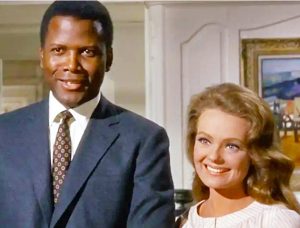
Sidney Poitier as Dr. John Prentice and
Katharine Houghton as Joanna Drayton.
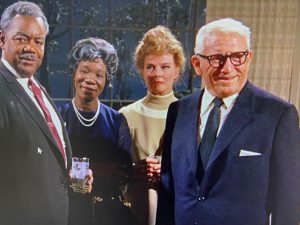
The parents of the young couple. L-R: Mr. Prentice (Roy E. Glenn, Sr), Mrs. Prentice (Beah Richards), Christina Drayton (Katherine Hepburn) and Matt Drayton (Spencer Tracy).