Women in the American Revolution
Part Eight of a Continuing SeriesBy Tom Madsen
Author’s Note: In April of 2025, the Market Messenger ran a seven part series to initially commemorate the 250th anniversary of the founding of our country. The series began with the Battles of Lexington and Concord (April 19, 1775) and ended with the “Olive Branch Petition” (July 5, 1775). We will continue this series now with certain periodic articles pertaining to the American Colonies quest for liberation in the first year of declared revolution (1776), including “The Committee of Five” (June 11) and the debate, vote and signing of the “Declaration of Independence” (June/July), the Battle of Trenton (the day after Christmas) and stories and deeds of individuals and groups who were willing to sacrifice everything for the cause of freedom.
Happy Birthday, America!
*****
“I long to hear that you have declared an independency – and by the way in the new Code of Laws which I suppose it will be necessary for you to make[.] I desire you would Remember the Ladies, and be more generous and favourable to them than your ancestors. Do not put such unlimited power into the hands of the Husbands. Remember all Men would be tyrants if they could. If perticuliar [sic] care and attention is not paid to the Ladies we are determined to foment a Rebelion [sic], and will not hold ourselves bound by any Laws which we have no voice, or Representation.”
-Abagail Adams, in a letter to her husband, John, on March 31, 1776
When we read about the Revolutionary War we are usually inundated with stories about the men who brought freedom and independence to America. To be sure, we are tacitly reminded of the role some women have played, such as Mercy Otis Warren, who wrote the “Conscience of the Revolution,” Sarah Bradley Fulton, who helped plan the Boston Tea Party and served as a combat nurse afterward, Ester DeBerdt Reed, who formed “The Ladies of Philadelphia” to raise substantial funds for the Continental Army and the venerable Abagail Adams, who was a relentless alter ego to her husband John, through correspondence during those trying times. There were others, less known to history, perhaps, but still displayed the uncommon courage that befits all who dared to take on a most powerful adversary: the British Empire.
There were many, some unknown to history for decades during those trying times that answered when called upon to do their part for the revolutionary cause. This essay will examine three women whose courage and cunning assisted in removing British rule from the American Colonies.
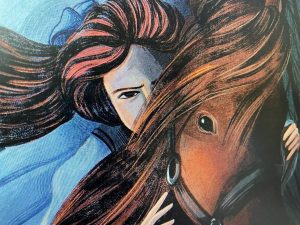
A 2022 painting by Chiara Fedele of Sibbel Ludington riding a fetch the American Militia against invading British troops.
SIBBEL LUDINGTON: On April 26, 1777, a force of British troops invaded the border town of Danbury, Connecticut, in search of colonial armaments, which they found and destroyed. They also found a store of whiskey, which they decided to imbibe. Drunk, they started to loot, ransack and burn the town.
Just over the line, in Duchess County, New York, Colonel Henry Ludington’s 400-man Yankee militia was on furlough. The colonel was warned of the carnage taking place at Danbury and before the drunken and violent British troops could get too far, he had to retrieve his soldiers, most of whom were home in nearby hamlets and villages. Colonel Ludington needed a courier to warn his men and to get them to return to the Duchess County headquarters.
Sibbel Ludington, the Colonel’s sixteen year-old daughter, was tasked to take the trip. She left on horseback at 9:00 p.m. in the rain. She found and alerted almost all of her father’s command and by morning the militia was on their way to intercept the British troops. While they were too late to save Danbury, the militia did drive the British from the area.
Sibbel, (her first name’s spelling has many variations, including Sybil) was a teenage girl who covered forty miles that night, more than double what Paul Revere and William Dawes did two years earlier during their famous “midnight ride” outside of Boston. It is said she also encountered British loyalists and “Skinners” (rogue highwaymen with no allegiance to either side), yet, the young girl was able to escape from them and continue on her mission.
Unfortunately, Sibbel’s fete was not recognized during her lifetime. While it is not known exactly when her story was finally told, it appears it may have been in 1907 when she was mentioned in a story about her father. It captured the nation’s imagination and proved that heroes come from all backgrounds, ages, genders and circumstances. Whether she volunteered or was commanded by her father is unknown, yet, the daring she showed, especially considering she had just turned sixteen, speaks volumes about the toughness and courage she displayed for the revolution.
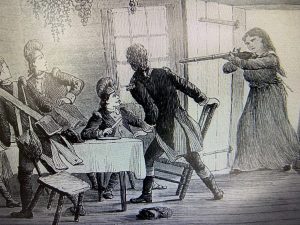
An undated pencil sketch of Nancy Morgan Hart
holding British soldiers at bay with a what was believed to be an unloaded rifle.
NANCY MORGAN HART: Nancy Morgan was born in North Carolina in 1744. She grew up rather tall and muscular. She had small pox as a child, which left scars on her face. She was temperamental and showed no fear, to which the local Cherokees labeled her “War Woman.” While she was illiterate, she knew how to survive on the frontier and was an excellent shot.
She married Benjamin Hart around 1771 and moved to northern Georgia. Nancy ran the household with an iron fist and had six sons and two daughters with Hart.
During most of the revolution, Nancy stayed with her children on the frontier, while her husband served in the Georgia militia as a lieutenant. She had to contend with the British and the Tories (colonists loyal to the Crown), who occupied the area.
During this time, Nancy managed to get into the British and Tory camps dressed as a man. She acted “feeble-minded,” so the British commanders would see no threat in this individual. Due to the charade, she was able to get close to the enemy leadership and gather information, which she passed along to the Yankee rebels.
But a major concern for Nancy was the closeness of the Tories and the British soldiers to their settlement and the threat they imposed on her family.
One day, six British soldiers came to her log cabin, killed her last turkey and demanded that she clean it and cook it for them. She had no choice but to agree. As they entered her cabin, they placed their muskets by the door. While they sat at her table awaiting the turkey, she served them a generous amount of corn-liquor. As they drank, she sent one of her daughters to warn her husband and other Patriots of the soldier’s presence. Then, as the soldiers continued to drink and eat, she began to sneak their muskets out of her cabin through a hole in the wall, but was caught in the act. As the soldiers began to confront her, she took a musket and killed one of the soldiers. She then shot another and held the others at gunpoint until her husband and the militia arrived. While the militiamen wanted the soldiers shot, Nancy, being a hard-hearted and determined rebel, said that was too good for them and demanded they be hung. They were and soon thereafter, the story of Nancy’s courage and viciousness spread throughout north Georgia. As the years went by, the story became legend and took on a variety of forms, but the essence of it remained: She withheld several British soldiers at bay with one, probably unloaded, gun.
In 1912, during the re-grading of a railroad right of way, over the land where the Harts once had their home, workmen unearthed a row of six bodies about three feet from the surface. Examiners said they appeared to be at least one hundred years old, which seemed to validate the legend of Nancy Morgan Hart. She may have shown no mercy toward her enemy and by today’s more humane standards, she could be considered quite brutal, but such was the way of her war when fighting for her homeland, her independence, her family and her very being.
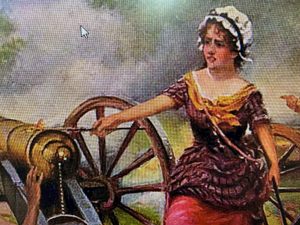
An undated artists rendition of Mary Ludwig manning a cannon from her exhausted husband during the Battle of Monmouth in 1778.
MARY LUDWIG (MOLLY PITCHER): During the American Revolution, it was common practice for wives of soldiers to accompany their husbands and to be nearby during hostilities to serve as nurses and carriers. Mary Ludwig was one such wife as she stayed near her husband who was a gunner in the Continental Army.
At the Battle of Monmouth near Freehold, New Jersey on June 28, 1778, a ferociously hot day, Mary Ludwig worked as a water carrier. She made trips to a nearby spring to haul water for the exhausted troops and to cool down their cannon. As legend has it, the soldiers called her “Molly Pitcher.”
During the battle, Mary’s husband collapsed due to the heat and was unable to man his cannon. According to those who were present, Mary dropped her water pitcher and took over for her husband on the cannon, facing a barrage of British small arms fire and cannonade. She remained at her post for the rest of the battle, which was one of the few the Americans won.
“Molly Pitcher” became a lasting and endearing symbol of the women who gave much of themselves for the sake of American independence; for they had to fight the war on two fronts. Not only did they maintain their homes, their farms and care for their children, they, too had to wage war against a powerful and unrelenting army in any way possible.
These were stories of three women. There are obviously more tales of the heroic deeds done by women of all classes, creeds and colors in the American Revolution. While their male counterparts may receive an overabundance of credit in history books, we cannot forget what these incredibly brave and determined women did for the cause of freedom, liberty and the birth of our nation.
“In bright array, they seek the work of war,
Where high unfurl’d the ensign waves in air.
Shall I to Washington their praise recite?
Enough thou know’st them in the fields of fight.”
-Phillis Wheatley, a young African slave from Boston,
who became known as the “Poet Laureate of the American Revolution”
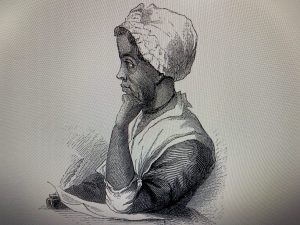
“Poet Laureate of the American Revolution,” twenty-three year old Boston slave Phillis Wheatley.