Slavery: America’s Abomination
Part Three: A Century of Violence, Protests and Turmoil with Hope on the Horizon
By Tom Madsen
“We are here this evening for serious business…. [W]e are American citizens and we are determined to apply our citizenship to the fullness of its meaning. We are here…because of our love for democracy, because of our deep-seated belief that democracy transformed from thin paper to thick action is the greatest form of government on earth.”
-Dr. Martin Luther King, Jr. during the Montgomery Bus Boycott, December 5, 1955.
After Union forces defeated the Confederates at Gettysburg on July 3, 1863, the Civil War, already leaning in the Union’s favor, decidedly went against the insurgent rebels. The next day, General Ulysses S. Grant captured the Mississippi River’s Confederate city of Vicksburg. The South was being choked from the Mississippi River to the Atlantic Seaboard (“Sherman’s March to the Sea”) and eventually north to Richmond, Virginia. The Union was winning the war of attrition. It was only a matter of time.
Six months earlier, in January of 1863, President Abraham Lincoln used the power of his office to push the South into an indefensible position, by issuing the Emancipation Proclamation, which declared all slaves held in states of rebellion were now free. The Civil War was no longer being fought solely to preserve the Union, but also to free a race of people who had been enslaved on American soil for over three hundred years.
The Proclamation fundamentally crushed any chance of European assistance to the South, as neither Great Britain or France could support a country that continued to fight for slavery. The Southern “Cause” no longer had legal or ethical merit.
Lincoln had successfully maneuvered the North onto the moral high ground.
As the Civil War was nearing its end, Lincoln and Republican members of Congress had been working on Constitutional amendment to make nation-wide slavery illegal. Slavery was implicit in the Constitution under what is commonly called the “three-fifths clause,” which declared certain people (slaves) in the United States would be counted as three-fifth of a person when determining that congressional districts would be proportioned by population. It was the South’s cynical way of securing more congressional seats (and power) for their states. The only sure way to abolish slavery was through the constitutional process.
In early 1864, the first attempt of getting Congressional approval for the 13th Amendment, which in part would make slavery illegal, passed in the Senate, but failed in the House by not securing the required two-thirds majority. It failed by thirteen votes. The vote was largely along party lines with Republicans in favor and Democrats opposed. While the Democrats argued the amendment would violate states’ rights, the Republicans declared slavery a disgrace and a violation of what the nation held dear, equality for all.
With his overwhelming re-election and Republican gains in the House and the Senate in the 1864 elections, Lincoln decided to make the 13th Amendment his legislative priority.
On January 31, 1865, after intense political wrangling, the House voted 119-56 in favor of the amendment, barely reaching the 2/3 majority needed for passage. By the end of February, eighteen states voted to ratify the Amendment, by December, the amendment would have its needed 27 states.
The effects of the 13th Amendment were felt almost immediately after ratification, as Lincoln’s Emancipation Proclamation was expanded to all states and included the nullification of the Fugitive Slave Act and the Three-fifths Clause in the Constitution.
While the 13th Amendment did eliminate the practice of slavery in the United States, it did not end the violence of racism.
In the years following Lincoln’s tragic assassination and the administrations of Andrew Johnson and Ulysses S. Grant, the remnants of the Confederate South found ways to usurp Reconstruction laws and replace slavery with other repressive acts, especially in the form of sharecropping, which replaced the plantation system of the antebellum South and kept families in economic bondage to the landowner. Families living on the former plantations owned by a third party were provided with housing and the tools to work the land. In return, the landowner got upwards to fifty percent of the profits from the crops, or shares, hence the term, sharecropping. This subjected ex-slaves into a feudal system where they were still beholden to a (usually) white landowner and could not get off the plantation due to indebtedness.
Even with sharecropping, reconstructing the South was still in place as Union troops were sent to assure there would be no “Confederate backlash.” With the support of the federal government, African Americans were afforded rights under the 13thAmendment and the 14th Amendment, giving black men the right to vote, equal protection under the law and full citizenship to all people born in the United States, with very few exceptions.
Later, after the extremely close and disputed 1876 presidential election, Republican presidential candidate Rutherford B. Hayes promised Southern Democrats he would weaken the Reconstruction laws and allow more local control over the South, in return for their votes in the House of Representatives to secure his election. Reconstruction essentially ended with that deal and the era of local “Jim Crow Laws,” which fundamentally ended any form of equal access to such vital rights as voting, housing and education to the former slaves, had begun.
Named after a derogatory and racist song and dance routine from 1828, the Jim Crow Laws were used by Southern whites as an attempt to return to the antebellum South and its class structure, which meant the eradication of rights afforded to blacks through the 13th and 14th Amendments. Without the presence of Union troops, which were relieved of duty after Hayes took over the presidency, the South used these racist laws to counter federal mandates. Violence toward black families isolated on former Confederate plantations increased and gave rise to white terrorist groups, like the Ku Klux Klan.
The Klan was first organized in Pulaski, Tennessee in 1865 as a “social club” for Confederate veterans. With Reconstruction and the 13th and 14th Amendments promoting equal and voting rights to former slaves, the Klan grew in popularity among the disenfranchised white population in the South. As the Klan flourished, claiming to be a “Christian” organization, brutal violence became its constant theme as black schools, homes and even churches were ransacked and, in many cases burned to the ground. Black citizens could not travel by night for fear of being attacked and, at times lynched, by bands of marauding white mobs.
In the meantime, Jim Crow laws flourished, as segregation became more prominent. Local laws forbade blacks from integrating within the white society, as almost all aspects of Southern life were separated between the races. But, most importantly, it restricted and essentially removed the only legal franchise ex-slaves had left – the right to vote. Southern officials used such restraints as polling taxes, grandfather clauses, literacy tests and overt displays of physical intimidation at the polls to lessen black participation in local elections.
The Klan grew into a terrorist organization that joined with the already racially violent Southern culture.
The terror that was perpetrated on black Americans in the South by a combination of racial, educational and social segregation and the ever-present violence, continued well into the 20th Century. Then, in May of 1954, the United States Supreme Court ruled unanimously that “separate but equal” was unconstitutional in their landmark decision, Brown v. the Board of Education. The Brown ruling was the beginning of the end for the repressive Jim Crow laws and eliminated the Court’s 1896 Plessy v. Ferguson decision, which made racial segregation legal.
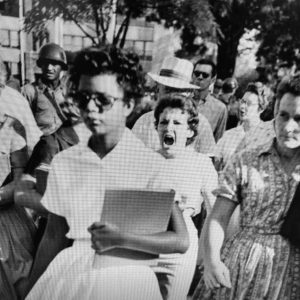
From 1954 to 1964, a series of events accelerated what became known as the Civil Rights Movement, by making the public aware of what the African American community had been experiencing for hundreds of years. Newsreel footage of black Americans marching for their constitutional rights, being water-hosed, attacked by police dogs and beaten by southern law enforcement finally made the rest of America take notice of their plight.
Perhaps the most visual and poignant act of civil disobedience by a black person was in 1955 when Rosa Parks refused to give up her seat to a white man on a Montgomery, Alabama city bus. Even though she was found guilty of some narrow-minded local law, her act of defiance prompted a yearlong bus boycott, which had a profound financial impact on Montgomery’s economy, while enhancing the image of the Civil Rights Movement, and gave it a face in the form of their charismatic young leader, Dr. Martin Luther King, Jr.
On September 9, 1957, President Dwight Eisenhower signed into law the Civil Rights Act of 1957, which was the most assertive civil rights legislation to date. Yet, even with civil rights in place through statue and court order, violence continued as black and white Americans rallied to the cause of basic human rights through such protests as, lunch counter sit-ins, voter registration drives and the brave, young, bi-racial Freedom Riders.
Still, the South and some communities in the North, continued to refuse court orders to desegregate schools and other public facilities. This was especially evident in June of 1963 when Alabama Governor George Wallace (“Segregation today, Segregation tomorrow, Segregation forever!”) defiantly stood in the doorway of the University of Alabama, blocking two black students from registering for classes. Finally, encouraged by his brother, Attorney General Robert F. Kennedy, President John Kennedy sent federal troops to the Alabama campus to ensure the student’s safe passage.
President Kennedy, who had taken a rather passive attitude toward civil rights up to that point, was so moved by television reports of protesters, both black and white, being harassed and beaten by vicious mobs, was compelled to address the issue to the nation on television. He gave his speechwriter, Theodore Sorenson, barely six hours to write the speech.
Receiving the final draft barely five minutes before airtime, Kennedy’s speech laid the groundwork for what was to become two of the most far-reaching civil rights laws in American history, the Civil Rights Act of 1964 and the Voting Rights Act of 1965. Both would be further strengthened and signed into law by Kennedy’s successor, President Lyndon B. Johnson.
With these landmark laws, even as the current Supreme Court has repeatedly and foolishly diminished the purpose and scope of the Voting Rights Act, basic human rights remain a pertinent issue and right, as we have witnessed a surge in white supremacy, coupled with the spectrum of hate that seems to be festering within our country.
While slavery itself is no longer a legal issue, its legacy continues to occupy our political landscape. If we are truly to be that beacon of freedom, we must continue to search and nurture what Lincoln so eloquently called, “the better angels of our nature.”
Without it, we cannot be that “shining city on a hill” President Ronald Reagan described America as, along with its ideals of liberty and equity our forefathers fought and died for.
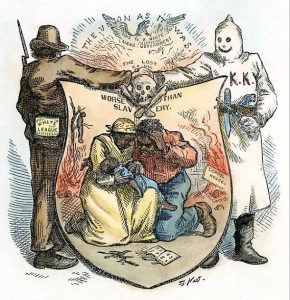
Thomas Nast political cartoon from the 1870s degrading the Jim Crow Laws and the racist southern attitude that usurped the federal Reconstruction Programs.
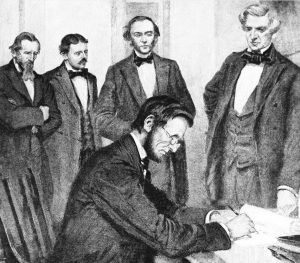
An undated pencil sketch of President Lincoln signing the Emancipation Proclamation.
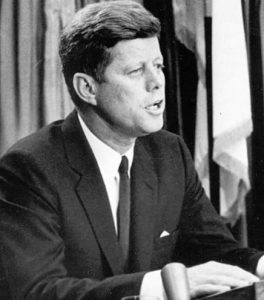
A White House photograph of President Kennedy addressing the nation about the violence in the South over civil rights in June of 1963.