Slavery: America’s Abomination
Part Two: The American Revolution, Compromises and the Growing Pain of Slavery
By Tom Madsen
“Slavery in an abomination and must be loudly proclaimed as such, but I own that I nor any other man has any immediate solution to the problem.”
Thomas Jefferson – date unknown
Thomas Jefferson characterized the contradiction of the American mind regarding the issue of slavery, equality and freedom during the late 18th and early 19th Centuries. He personally stated in writing and in speech his disgust of slavery, yet, he was a slaveholder and did not free his slaves when he was able to. Even Sally Hemings, his mulatto house slave and his late wife’s half-sister, with whom he had upwards to six children, was not freed during or after his lifetime. As a matter of fact, the only slaves Jefferson freed were Hemings’ two brothers and her (and his?) children as they reached the age of majority. Some historians will say Jefferson was a hypocrite, yet others stress the conflicting nature of Jefferson’s thinking was emblematic of what America thought about holding Africans as indentured property.
After the American Revolution, as the United States began expanding westward, the issue of slavery was a major factor in regard to organizing potential political regions. As territories sought statehood, it became a matter of debate as to whether they were going allow slaves or not. This, of course led to provincial tensions as the South wanted more states to allow slavery, thus ensuring not only its traditions, but its longevity as well. While the North, which had become mostly anti-slavery due to its industrial nature and Western European traditions, wanted the new states to reject the South’s “peculiar institution.”
The first real test came in 1817 when Missouri applied for statehood. Missouri was part of the Louisiana Purchase and was the second territory from that massive tract of land (Louisiana, obviously, was first) to seek “membership” in the Union. The leaders in Missouri had intended it to become a slave state, which was rejected by Northern delegations in Congress.
New York Representative James Talmadge sought a compromise by proposing in exchange for statehood, Missouri would not be allowed to bring in any new slaves. He also proposed that children of slaves already in Missouri would be granted their freedom when they turned twenty-five. As controversial as it seemed at that time, the House approved Talmadge’s proposal along regional lines, but the Senate rejected it.
In the meantime, Maine had also been seeking statehood, but was stalled in the Senate by the Southern delegations. To end the stalemate, what became known as the Missouri Compromise, was negotiated in 1820, which established Maine as a free state and Missouri as a slave state. There was, however, one caveat; no territory north of Missouri’s southern boarder (the 30th parallel) would be allowed into the Union as a slave state, thus eliminating a good portion of the Louisiana Purchase from the slave issue.
While the Missouri Compromise allowed Congress to regulate slavery in the territories and the new states, the next great issue facing the country would be how far could the federal government reach in controlling slavery and when would state’s rights come into play?
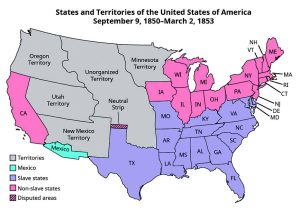
Thirty-four years later, as the country continued to be torn over the issue of slavery, the Kansas-Nebraska Act of 1854 would essentially eliminate the Missouri Compromise by removing the provision that slavery could not go beyond the 30th parallel. The Act also established the separate territories of Kansas and Nebraska and allowed the voters of each territory the “popular sovereignty” to determine whether slavery would be allowed or not.
Preceded by the Compromise of 1850, where California was brought into the Union as a free state and the citizens of the New Mexico and Utah territories were allowed to determine for themselves whether to be free or slave; the powers in Washington thought the Kansas-Nebraska Act would at least eliminate some of the animosity the issue of slavery was causing between the states. It did just the opposite. It incited more violence, so much so, that Kansas became known as “Bleeding Kansas.”
John Brown, a religious and abolitionist zealot, who advocated a violent overthrow of slavery, used the Kansas-Nebraska Act to incite riots in the Kansas Territory. He and four of his sons, along with several escaped slaves, murdered five alleged pro-slavery settlers who lived near Pottawattamie Creek (Potawatomi?). Brown claimed he was doing “God’s bidding” and was “commanded” to kill the settlers. He soon became a hero to the radical anti-slavery forces in the North. By 1858, Brown and his sons were able to recruit a “small” army of insurgents, whose mission was to provoke a slave rebellion within the United States. In October of 1859, Brown led a raid on a munition’s arsenal at Harper’s Ferry in Virginia. It was an ill-conceived plan as Brown and his men were overrun by troops commanded by then-Colonel Robert E. Lee. Brown was wounded, then captured. He was later tried for treason. He used as a defense his inspiration from God and that he was a “self-sacrificing religious idealist.” Never the less, he was convicted and hanged on December 2, 1859, but his legacy lived on within the more violent and radical factions of abolitionist movement, which continued to advocate for any means possible to end slavery, including a vicious slave insurrection. Brown, in death, became a martyr through song (“John Brown’s body lays a molten in the grave…”) and in spirit, as both sides of the slavery issue increased hostilities between the states and became more entrenched.
In politics, the fledgling Republican Party, formed by abolitionists and free traders, ran famous explorer and soldier, John C. Fremont (“Free Soil, Free Labor, Free Speech, Free Men and Fremont”) as their first presidential candidate in 1856. Even though he lost to pro slavery Democrat James Buchanan, the Republicans gained a foothold in New England, New York, the northern Midwest, and the Great Lakes states, as they championed the anti-slavery movement and would be an up-and-coming political force going into the 1860 presidential campaign.
In 1857, the United States Supreme Court’s Dred Scott decision further divided the nation. Dred Scott was a slave owned by John Emerson of Missouri, a slave state. In 1843, Emerson took Scott to the Louisiana Territory, where slavery was banned because of the Missouri Compromise. After some time, they returned to Missouri. Scott sued for his freedom in a Missouri court because he had lived in Louisiana and, by law, was a free man. After two court hearings, one, a ruling by a district court found Scott to be a free man, and the other, the Missouri Supreme Court, ruled he was not; the case would go before the United States Supreme Court.
During this time Emerson died and his widow left Missouri. She later sold Scott to a John Sanford from Upstate New York. Scott’s attorneys filed suit for his freedom in a New York Federal Court, which ruled in favor of Sanford (the district court misspelled Sanford’s name to Sandford and that is how it is titled in the Supreme Court case) who wanted to keep Scott as a slave.
The Supreme Court faced two constitutional questions: First, were slaves and their descendants’ considered citizens under the U.S. Constitution and, second, if they were not citizens, were they able to file suit in American courts under Article III of the Constitution?
On March 6, 1857, the Court ruled against Scott in a 7-2 decision. In the majority opinion, Chief Justice Roger B. Taney, an Andrew Jackson appointee from a wealthy Maryland slave-holding family, wrote that slaves “are not included and were not intended to be included, under the word ‘citizens’ in the Constitution, and can, therefore, claim none of the rights and privileges which that instrument provides for and secures to citizens of the United States.”
Taney continued, “There are two clauses in the Constitution which point directly and specifically to the negro race as a separate class of persons, and show clearly that they were not regarded as a portion of the people or citizens of the Government then formed.”
Taney also declared that while slaves could be considered citizens of a state, they were not federal citizens and could not, therefore, file suit in federal court.
Although it was not part of the case, Taney’s Supreme Court also overturned the Missouri Compromise and ruled the U.S. Congress did not have the constitutional authority to ban slavery.
The Dred Scott Decision further polarized an already deeply divided country. It would only be a matter of time before both sides would have to finally settle the question in the only method left to them – armed conflict.
The election of 1860 was perhaps the most significant and far-reaching presidential contest in the young country’s history, with slavery at the center of it. The Republican Party nominated anti-slavery candidate Abraham Lincoln, a former one term congressman from Illinois, while the badly split Democrats nominated moderate Senator Stephen Douglas also from Illinois. Two others ran as third-party candidates, John Breckinridge, a supporter of slavery, who ran as a Southern Democrat and John Bell from the pro-slavery Constitutional Party. Both candidates took votes away from Douglas, thus ensuring Lincoln’s election. He won with 40% of the popular vote, but a clear majority in the Electoral College.
Before the election, many Southern states declared if Lincoln won the presidency, they would leave the United States. Just weeks before his inauguration, a total of eleven Southern states seceded from the Union and formed the Confederate States of America.
On April 12, 1861, Confederate batteries began shelling Union held Fort Sumter off the coast of South Carolina.
The Civil War had begun.
A war that had been festering for decades and a war that, in a way, symbolized America’s political and social adolescence; a country at war with itself. It would be the bloodiest war in the nation’s history, and at its core, lay the political, economic and moral issue of slavery.
Next: Part Three: A Century of Violence, Protests and Turmoil, with Hope on the Horizon
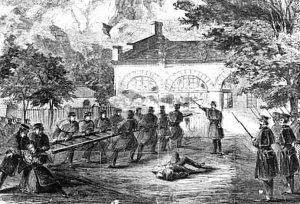
An illustration from Harper’s Weekly showing the United States Marine Corps attack on a firehouse John Brown used as his fort/headquarters during his raid on Harper’s Ferry.
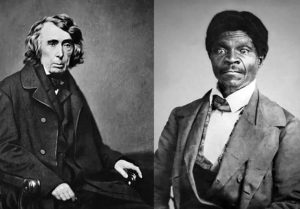
The two antagonists of the infamous Dredd Scott case: United States Supreme Court Chief Justice Roger Taney and Dredd Scott.