Walter Reuther, the UAW and Labor Day
By Tom Madsen
“There is no power in the world that can stop the forward march of free men and women when they are joined in the solidarity of human brotherhood.”
-Walter Reuther, April 1970
In May of 1935, after years of trying to organize workers from the auto industry for collective bargaining purposes, the newly formed Committee for Industrial Organization (CIO – later re-named the Congress of Industrial Organization), began looking at that growing endeavor as a target for union representation. The beginning of that movement came when two hundred workers representing auto plants from across the United States met in Detroit, which would lead to the founding of the United Auto Workers (UAW).
With the enactment of the National Labor Relations Act of 1935 (commonly referred to as The Wagner Act), unions, seeking to represent workers were given protection from retaliation by employers, which, on the face of it, should have been ample protection for fledgling unions like the UAW. Even though they were now legally safeguarded, many in management would find ways to curtail their progress.
Over the next ten years, the UAW found some success organizing workers from smaller manufacturers. But it was “the Big Three” (General Motors, Ford and Chrysler) that would prove to be more difficult, even dangerous. Protected by the Wagner Act, the UAW still had to use “extreme” measures to get the Big Three to the bargaining table. That was finally accomplished through “sit-down strikes.” The first took place at a General Motors (GM) plant in Atlanta, then in Kansas City and Cleveland. But the most famous was at the GM Body Plant in Flint, Michigan on December 30, 1936. At 8:00 p.m. the second shift workers merely stopped what they were doing, locked themselves in and literally sat down around the plant. One worker loudly exclaimed, “She’s ours!” And, so it was.
The UAW, already a recognized union through legal processes, went on strike for several reasons: acknowledgment by the company that the UAW was the sole bargaining agent for the workers; to force the company from sending union work to non-union shops, to establish a minimum wage scale, a grievance procedure and to set practices that would protect assembly line workers from injury on the job.
The workers occupied the plant for forty-four days. It was one of the most audacious actions on the part of a union in American labor history. While not spontaneous like legend would have it, the strike was well-planned and carried out after months of preparation.
General Motors claimed the strikers were trespassing and got a court order demanding they leave the premises. The union refused. The heat was turned off; still the workers found ways of keeping warm. On January 11, 1937, the police tried to cut off the striker’s food supplies, which ended up with a riot known as the “Battle of the Running Bulls.” Sixteen workers and eleven police were injured in the clash. By February 1, the UAW had taken over two more buildings, the Fischer Body Plant #2 and the sprawling Chevrolet #4 Engine Plant. GM’s production went from 50,000 cars in the month of December to 125 in February.
Michigan Governor Frank Murphy refused to use force to remove the strikers and even though sit-down strikes were illegal, he did not call the National Guard to break it up. He told the press, “If I send those soldiers right in on the men, there’d be no telling how many would be killed. The state authorities will not take sides. They are here only to protect the public peace.”
In the meantime, President Franklin Roosevelt pressed General Motors to recognize the UAW, so the plants could reopen. By mid-February, GM relented and signed an agreement with the union. The workers received a five percent raise and were allowed to speak in the lunchroom for the first time.
The next target for the UAW was the Ford Motor Company. Even with a favorable Supreme Court ruling on the Wagner Act, Ford had a long history of rejecting union organizational efforts and was prone to use violence. One such incident did occur, known as “The Battle of the Overpass,” where “employees” from the Ford Service Department attacked and brutally beat UAW organizers Walter Reuther, Robert Kantor, Richard Frankensteen and J.J. Kennedy, who were handing out union literature on a public pedestrian overpass where Ford employees from the company’s River Rouge Plant walked during shift change. The Service Department “employees” also attacked photographers, reporters and women from UAW’s Ladies Auxiliary. As a result of the “Battle”, a strike ensued essentially crippling the River Rouge Plant, which finally forced Ford to recognize the UAW as the bargaining agent for Ford employees, but not until 1941. It did, however, heightened Walter Reuther’s leadership within the UAW.
*****
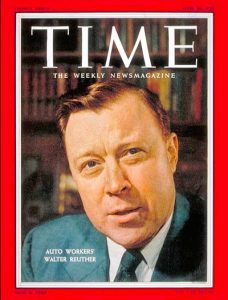
Walter Reuther was born on September 1, 1907 in Wheeling, West Virginia to German-American parents, Valentine and Anna Stocker Reuther. Walter was the second oldest of five children (three brothers and one sister). His father was a beer wagon driver and a socialist. He immigrated to the United States when he was eleven. Valentine Reuther often taught his sons about current political issues, including child labor, civil rights, yellow journalism and women’s suffrage. He spent time discussing the evils of racism and economic inequality; an education Walter would keep for the rest of his life.
At the age of nine, Walter began working odd jobs to augment the family income after Valentine lost sight in one eye in a bottle explosion. By the time he was sixteen, Walter, bored with high school, dropped out to become an apprentice tool and die maker. He was fired sometime later after he tried to organize a union. In 1927, he moved to Detroit and began working for Ford as a mechanic at their River Rouge Plant. While working the night shift, Reuther attended classes and earned his high school diploma at the age of twenty-two. He then took college courses at Detroit City College (Wayne State University). Soon thereafter, his younger brothers Victor and Ray joined him.
Over the next nine years, the Reuther brothers became involved in many activities, including the Socialist Party. They organized protests when the college started a Reserve Officer Training Corps (ROTC) on campus and against the segregationist policies of a local swimming pool leased by the college. In 1933, he and Victor went on a nine-nation tour of Europe, beginning with Nazi Germany. They ended the tour in the Soviet Union where they worked in a massive automobile plant for two years.
Reuther returned to Detroit in 1935, where he met and married May Wolf, a physical education teacher and Socialist Party activist. They purchased a modest home in Detroit and had two daughters.
Reuther then volunteered to organize local unions for the UAW. He joined the newly created UAW Local 86, which represented workers at GM’s Ternstadt Parts Plant, even though he was not an employee. He was elected as a delegate to the UAW national convention in 1936, where he was elected to the UAW’s Executive Board.
He returned to Detroit as a paid UAW official and began organizing more local chapters. In less than a year, UAW Local 174, which Reuther was president, represented 30,000 workers in seventy-six factories. In 1937 he played a major role in organizing the sit-down strike in Flint, Michigan.
In 1939, Reuther became the director of the UAW’s General Motors department and in 1942 was elected the union’s vice president. Just after World War II started, he was appointed to the Office of Production Management, the War Manpower Commission and the War Production Board. He was respected by both union and management as a steadfast leader in the Labor Movement. In 1944, an illegal wildcat strike took place at several GM plants. Reuther was skillful at defusing the crisis, which further enhanced his standing both within the union and automotive industry.
In 1946 he led a 116-day strike against GM, demanding a 30% raise without an increase in the price of their autos. He challenged the company to “open their books” to prove the 30% pay increase was detrimental to GM’s financial stability. The company refused, but counter-offered an 18% increase, which the UAW accepted.
Later that year, Reuther was elected president of the UAW in a very close race, defeating the incumbent, R.J. Thomas by 124 votes. He would be a new generational leader, as he viewed the Labor Movement as “an instrument for social change.”
Even though there would be labor strife between the auto industry and the UAW over the next twenty years, both sides negotiated and agreed on such innovative considerations as grievance procedures, health benefits, pensions and safety measures. Due to the cyclical nature of the auto industry, the UAW was successful in negotiating “supplemental unemployment benefits” (SUB pay) that enabled UAW members to receive 95% of their take home pay when they were laid off.
Even though he grew up in a “socialist” household and he worked in the Soviet Union for two years, Reuther was an anticommunist and actively decreased Marxist influence that had seeped into the leadership of the UAW. In 1947, Life Magazine reported that Reuther’s re-election, as UAW president was “the biggest setback of all time for the Communists in the American Labor Movement.”
In 1948 he was the victim of an assassination attempt where he lost partial use of his right arm and had to teach himself to write left-handed. The gunmen were never found.
During his tenure with the UAW, Reuther was a tireless leader in the Civil Rights Movement and was with Martin Luther King during the March on Washington in August of 1963. He met regularly with President Lyndon Johnson throughout 1964 and 1965 to discuss social programs and policies.
On May 9, 1970, Reuther, his wife, May and six others were killed in a plane crash while travelling to the UAW recreational and educational center near Black Lake, Michigan.
This week, as we commemorate Labor Day and the efforts of those who toil on behalf of our country, we should reflect on leaders like Walter Reuther, who was instrumental in expanding the lives of workers, which further enhanced America’s vibrant middle class, the backbone of our economy. He never sought to aggrandize his life or his lifestyle. He was an unassuming man, who happened to lead a union through its most productive era; and secured for working class families the chance for a better life.
“We are the Union; we shall not be moved…”
This essay is dedicated to the memory of United Auto Workers Local 72 in Kenosha, Wisconsin, of which this writer was once a member.
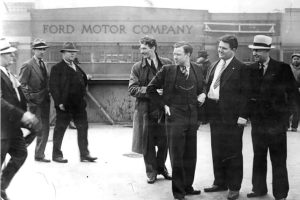
Reuther (third from the left) and other UAW organizers seconds before being attacked by Ford Company “employees” at what was known as “The Battle of the Overpass”
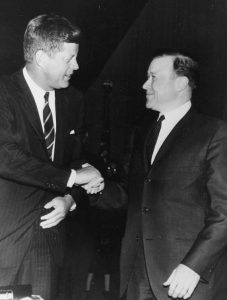
Walter Reuther with President Kennedy in 1963.